How Do You Handle Stress? 🌊
A reflection on the moves you reach for when pressure hits — fixing the problem, soothing the feeling, calling for backup, or shifting the meaning. Use it to spot your default and add the moves you're missing. Not a clinical assessment.
No sign-up required. Your answers aren't stored anywhere.
What this quiz is
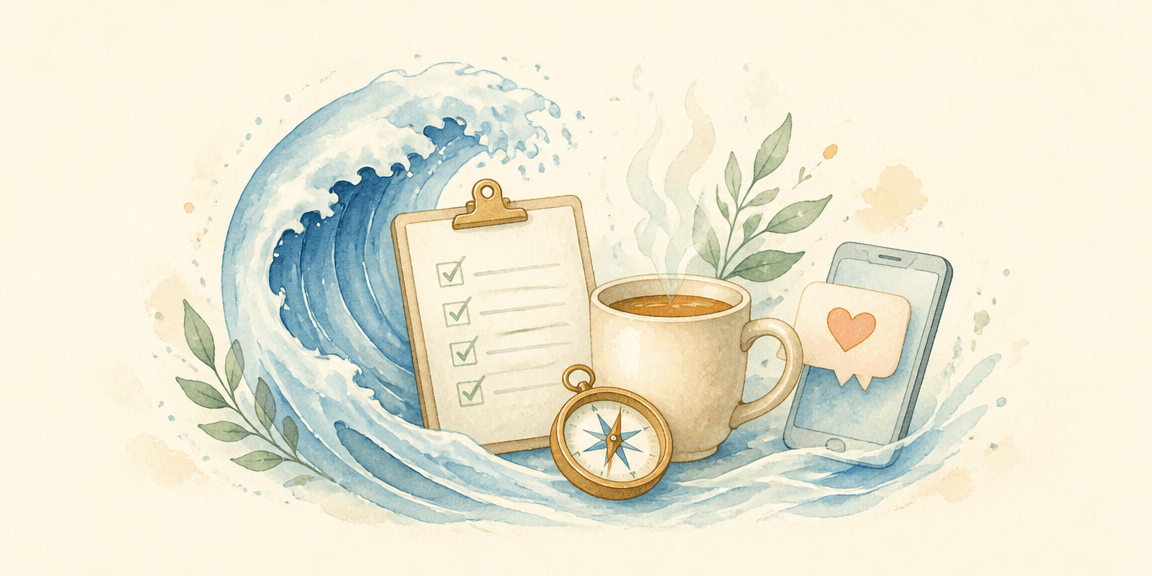
Bad email lands, hard call ends, the deadline moves up — and in the first five minutes, before you've decided anything, your hands already know what to reach for. This quiz watches that first reflex. Some people open a doc and start mapping; some go breathe and drink water; some grab their phone to call a person; some go quiet and ask "okay, what is this actually about." It sorts you into one of four coping moves so you can name your default and, more usefully, notice the move you keep skipping. It's a self-reflection, not a clinical stress assessment.
How to use your result
If a line lands tender, slow down there instead of scrolling past — that reaction is the most useful data this quiz produced. And if the topic feels heavy rather than curious right now, a conversation with a licensed professional will do more than a retake.
A quiz can point at a pattern; whether the pattern is real gets settled by your actual weeks, not by the result page.
How results work on SelvoraHow this test was designed
- What it measures
- Which of four coping moves your hands reach for first when pressure hits: fixing the problem (action), settling your own nervous system (soothing the body), calling for backup (reaching out), or shifting what the thing means (reframing). It's a snapshot of your default move and the moves you under-use — not a verdict on whether you "cope well." The point isn't that one move is best; it's that each one is right for a different kind of stress, and most of us over-rely on one.
- Why these questions
- Every question drops you into a specific pressure scene — the first five minutes after bad news, 1am insomnia, the night before something big, the moment things actually went wrong — and asks what you'd genuinely do, not what you'd ideally do. We use scenes instead of "rate how stressed you get" because the same person answers those rating scales politely and then does something completely different in real life. Two of the questions deliberately ask for your worst habit and the words you'd most want said about you, so the read isn't just your best self performing calm. The four options in each scene map onto the same four coping moves, so it's the pattern across ten scenes — not any single answer — that decides your default.
- How the result is divided
- Each answer pours weighted points into one or two of the four coping buckets — a "call a friend" choice mostly feeds Connection Seeker with a splash of Emotion Soother, and so on — so a single odd answer can't flip your whole result. After ten scenes, the bucket with the most points becomes your default move: Problem Solver, Emotion Soother, Connection Seeker, or Meaning Maker. The result pages are written so each one names exactly where that move is gold and where its shadow is (the problem solver who lists instead of feeling, the soother who hides in long baths, the seeker who outsources their own thinking, the meaning maker who reframes before the hurt has even landed) — and every type ends with the specific move it tends to skip.
- Please do not
- Don't read your result as "the right way you handle stress" and write off the other three — the whole quiz is built on the idea that grief isn't a logistics problem, a deadline isn't soothed away by a hot shower, and some things need an action, not a paragraph about resilience. And if the pressure in your life right now is the kind that doesn't lift no matter which move you reach for, that's a sign for a real conversation with a licensed professional, not a sign to retake the quiz.
What this quiz can help with
- •Give one plausible name for a pattern you have been noticing in yourself.
- •Suggest specific moments this week where you can watch the pattern in real time.
- •Open a conversation with someone close about closeness, distance, and reassurance.
What this quiz cannot do
- •Diagnose anxiety, depression, ADHD, attachment disorders, or any clinical condition.
- •Replace therapy, counseling, or a relationship with a qualified professional.
- •Predict how a specific relationship or situation will turn out.
Related reading
Why Personality Tests Are Fun — But Not Diagnostic
There's a real, important line between a personality quiz and a clinical diagnosis. A clear-eyed walk through what each one actually is, why one entertains and the other treats, and how to enjoy quizzes without confusing them for medicine.
The Big Five, Without the Jargon
Five sliders instead of sixteen boxes. Why researchers trust the Big Five, what each trait looks like at the coffee machine, and where it quietly stops.
Emotional Intelligence Is Four Muscles, Not One Gift
EQ isn't a trait you have or lack. It's four trainable skills, and they show up in the most ordinary moments of your week.
More Psychology quizzes
What's Your EQ Style? 🧠💛
A playful reflection on the four emotional-intelligence muscles you naturally lean on — noticing feelings, managing them, reading other people, or connecting with them. For entertainment and self-reflection, not a clinical EQ test.
What's Your Attachment Style?
A light reflection on the attachment patterns your answers lean toward — secure, anxious, avoidant, or disorganized — and what that might mean for how you show up in relationships. Entertainment and self-reflection only, not a clinical diagnosis.