The Big Five, Without the Jargon
Five sliders instead of sixteen boxes. Why researchers trust the Big Five, what each trait looks like at the coffee machine, and where it quietly stops.
The friend who is hard to label
Think of someone you know well who refuses to fit a clean box. She's the most organized person in your group chat — color-coded spreadsheets, never misses a flight — and also the one who cries at the gate when a trip ends. She'll talk to a stranger for an hour, then go quiet for three days and not text anybody. If you tried to stuff her into a four-letter type, you'd lose half of what makes her her.
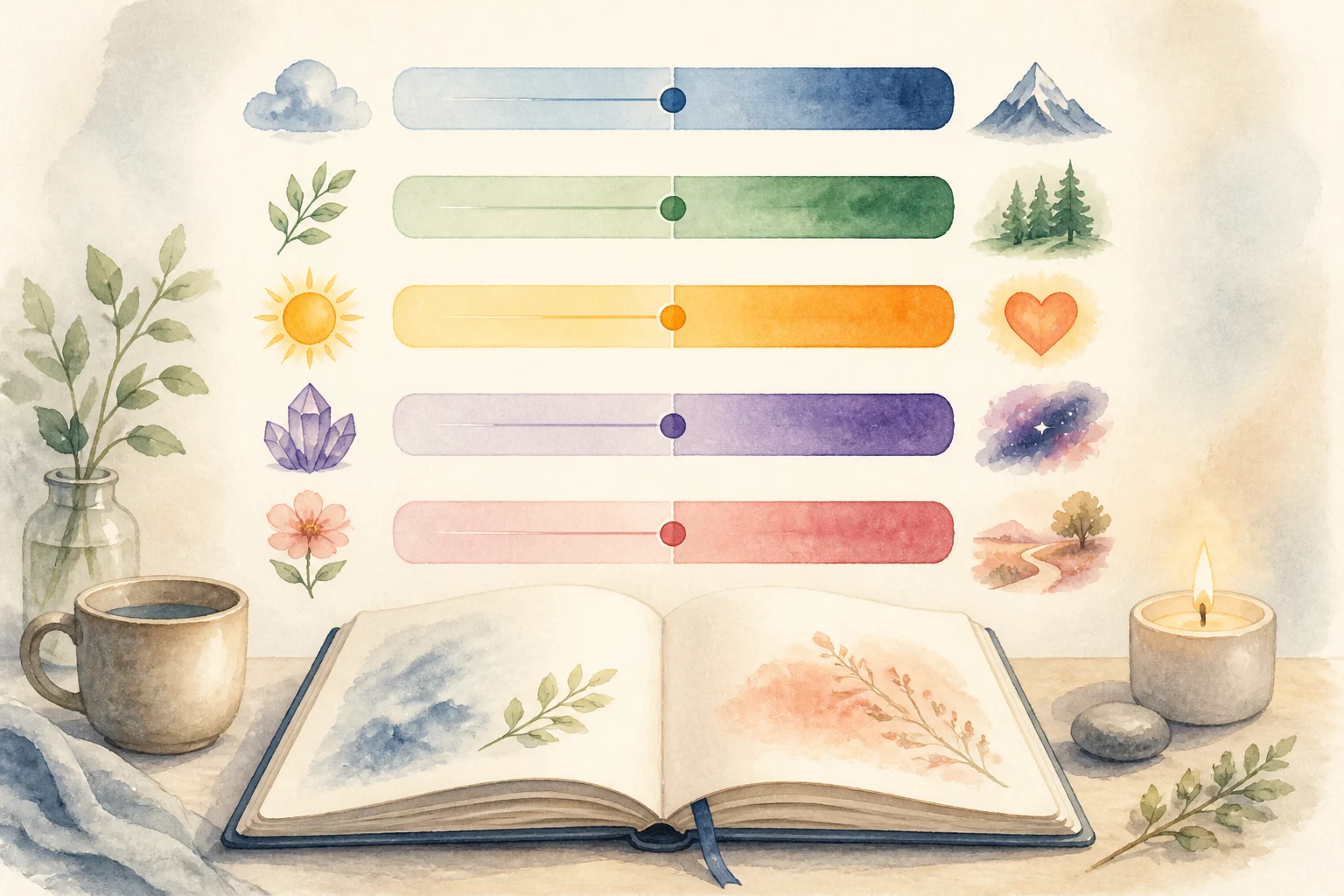
That gap is the whole reason psychologists tend to use a different tool. The Big Five doesn't ask "which of these sixteen people are you?" It asks five separate questions and lets your answers land wherever they land. You're not a box. You're five sliders, each set somewhere between low and high, and the particular combination is the thing that's actually you.
Why the lab trusts five sliders
Here's the honest reason researchers reach for the Big Five and side-eye MBTI-style typing. The five traits weren't dreamed up by one person with a theory. They fell out of decades of statistics. Researchers took thousands of adjectives people use to describe each other — kind, lazy, jumpy, curious, blunt — fed them into the math, and watched them cluster. Again and again, across languages and cultures, the same five clusters kept showing up. The model is, in a real sense, a map of the words humans already use for personality.
The more practical reason is that the Big Five behaves itself when you test it. Take it today and again in six months and your scores barely move. MBTI famously doesn't manage that — a chunk of people who retake it land on a different type within weeks, which is a bad sign for something that calls itself a type. And because the Big Five reports a degree rather than a category, it doesn't pretend the world splits cleanly into introverts and extraverts at some magic line. It just tells you roughly where you sit on a crowd. If you want the longer version of why "how accurate is this?" is the right question to ask of any test, the psychology hub circles that one a lot.
None of this makes the Big Five glamorous. It will never give you a tidy tribe to belong to. That's sort of the point.
The five traits at the coffee machine
Forget the textbook definitions. Here's what each trait looks like in a normal office kitchen.
Openness is the appetite for the new. High-openness people are the ones who try the weird fermented thing, change their mind after a good argument, and keep a half-read pile of books on three unrelated subjects. Low-openness isn't dumb or closed — it's a preference for the proven, the concrete, the thing that already works. The high-openness colleague pitches the experimental project; the low-openness one quietly makes sure it ships.
Conscientiousness is the part of you that does the boring thing on time. High scorers plan, follow through, and feel a small physical discomfort when a deadline slips. Low scorers are more spontaneous and flexible, and more likely to start five things and finish two. This is the trait that, honestly, predicts the most about how a life goes — more on that in a second.
Extraversion is where you get your charge. Extraverts come back from a loud party with more energy than they left with. Introverts enjoy the party and then need a quiet evening to refill the tank. It's not about shyness, and it's not about whether you like people. It's about what drains you and what feeds you.
Agreeableness is your default setting toward other people. High-agreeableness folks assume good intent, smooth over friction, and hate conflict enough to swallow their own preference. Low-agreeableness people are more skeptical, more comfortable saying the blunt thing, and — fair warning — more likely to win a negotiation. Neither end is the "good" one. A team of pure agreeableness never says the hard truth. A team of pure disagreeableness never gets lunch ordered.
Neuroticism is how reactive your alarm system is. High scorers feel stress, worry, and mood swings more intensely and more often. Low scorers stay flat under pressure in a way that can look enviable and can also mean they miss the warning the worriers caught. The unfortunate name makes it sound like a flaw; it's just a thermostat, set sensitive or set calm.
Notice nobody here is a type. Your worried, organized, party-loving friend is high on neuroticism, high on conscientiousness, high on extraversion. Three sliders, one person, no contradiction.
Your score is a percentile, not a verdict
This is the part people skim, and it's the part that matters most. When a Big Five report says you scored "72 on extraversion," that number is not a measurement of you in isolation. It's a comparison. It means roughly that out of a hundred people who took the same test, you came out more extraverted than seventy-two of them. The score only exists relative to the crowd.
So a few things follow. There's no line where you cross from introvert to extravert — the whole population spreads out in a smooth hill, most people bunched in the middle, fewer out at the edges. "Ambivert" isn't a special type; it's just the enormous middle of the curve, which is where most of us live. And your number can drift a little depending on who took the test alongside you and how you read the questions that day. A percentile is a useful pin on a map. It is not your fixed coordinates for life.
Which is also why the right move after a result is curiosity, not adoption. "I scored low on conscientiousness" is an observation worth chewing on. "I'm a low-conscientiousness person, that's just who I am" is a sentence quietly doing more work than the data earned. The guides on using any test result well keep hammering this distinction, because it's the one people get wrong.
What it actually predicts, and what it just doesn't
Let's be specific, because vague claims are how personality content goes bad.
Conscientiousness is the workhorse. Across a lot of research it's the trait most tied to doing well in school and holding down a job, and it has a quiet link to living longer — probably because conscientious people wear seatbelts, take the medication, and don't gamble the rent. Neuroticism tracks with how much day-to-day stress and low mood a person carries, which matters for wellbeing. Extraversion lines up with how big and active a social life tends to be. Openness shows up in creative fields and in who enjoys ambiguity. These aren't huge, destiny-sized effects. They're real, modest, statistical nudges that show up across thousands of people and tell you almost nothing guaranteed about one specific person — namely, you.
And here's the honest other half. The Big Five is bad at predicting a single decision on a single Tuesday. It won't tell you whether you'll quit your job, who you'll fall for, or whether you'll be happy in Lisbon. It doesn't measure your values, your skills, your intelligence, your history, or how much sleep you got. A high-conscientiousness person having an awful month will out-flake a low-conscientiousness person having a great one. Traits are the long-run tilt of the table, not the roll of any one die.
So if a test result ever feels like a prophecy, that's the moment to trust it less. It's describing a tendency, in the aggregate, on average. Real life happens in the exceptions.
Where even the good model runs out
I like the Big Five. It still has limits worth saying out loud.
It's a self-report. You answer questions about yourself, and people are not flawless narrators — we round up on the flattering traits and round down on the ugly ones, sometimes without noticing. The labels carry baggage, too. "Neuroticism" sounds like an insult and "agreeableness" sounds like a compliment, but a low-agreeableness surgeon who tells you the blunt truth is exactly who you want in the room. The five traits also don't capture everything that matters about a person; there are real arguments for a sixth dimension around honesty and humility, and the model says nothing about your moral character, your sense of humor, or what you'd run into a fire to save. It maps the broad shape of temperament. It does not contain a whole human.
And a clinical-grade Big Five assessment, scored carefully, is a different animal from a free quiz you took between subway stops. The free version can absolutely give you a real, useful nudge toward self-understanding. It cannot diagnose anything, and it shouldn't try.
Which is the right note to end on. Treat your five sliders as a decent mirror, not a sentence. The most interesting thing about them isn't the numbers — it's the moment you notice yourself acting against your own slider and wonder, for a second, why. That little gap between your pattern and your choice is where you actually live.
One last thing, plainly: this is self-reflection for fun and a bit of insight, not a clinical assessment or professional advice. If something here pokes at a real struggle, a good therapist beats any quiz, including ours.
More from this hub
What Personality Tests Can — and Can't — Tell You About Your Mental Health
A trait quiz and a clinical screening do two genuinely different jobs. Here's the honest line between a description and a diagnosis, why a quiz can't diagnose anxiety or ADHD, and when to talk to a professional instead.
Emotional Intelligence Is Four Muscles, Not One Gift
EQ isn't a trait you have or lack. It's four trainable skills, and they show up in the most ordinary moments of your week.
Problem-Focused vs Emotion-Focused Coping: Matching the Move to the Stressor
Five coping styles, none of them universally best. The skill is matching the move to the stressor — and knowing when the stress has outgrown what coping alone can fix.