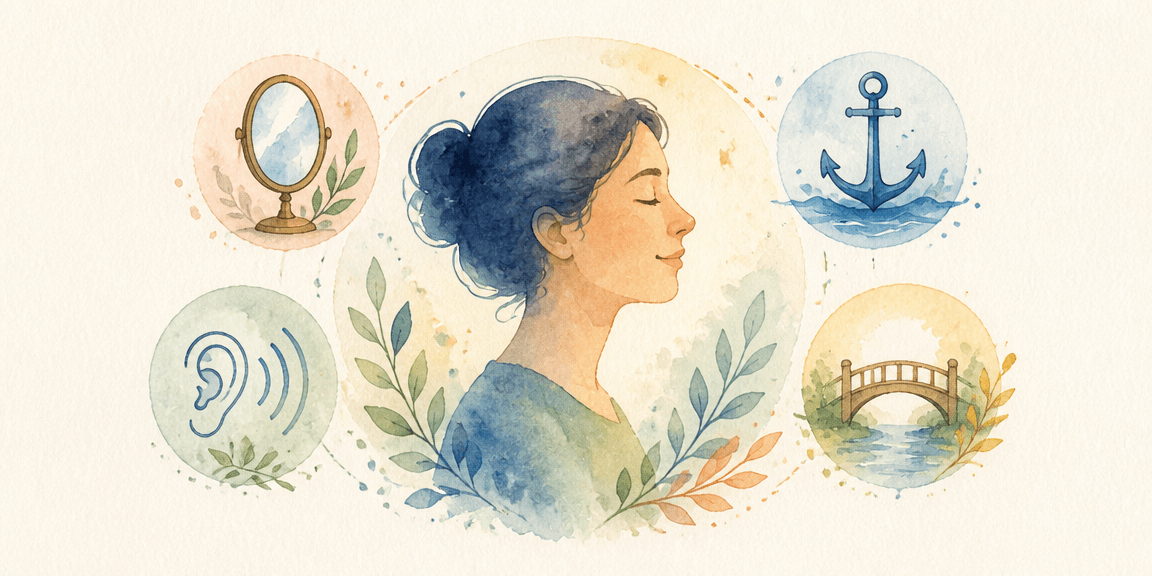
What's Your EQ Style? 🧠💛
A playful reflection on the four emotional-intelligence muscles you naturally lean on — noticing feelings, managing them, reading other people, or connecting with them. For entertainment and self-reflection, not a clinical EQ test.
No sign-up required. Your answers aren't stored anywhere.
What this quiz is
Emotional intelligence isn't one thing you either have or don't — it's four separate muscles, and almost nobody is equally strong in all of them. This quiz drops you into ordinary moments (a friend cancels last-minute, your boss criticizes your work, your partner says "I'm fine" in a tone that clearly means not fine) and watches which muscle reaches for the situation first: naming what you feel, steadying yourself, reading the room, or moving toward the person. The result is the muscle you lean on, not a grade — and the most interesting part is usually the one you scored lowest on.
How to use your result
If a line lands tender, slow down there instead of scrolling past — that reaction is the most useful data this quiz produced. And if the topic feels heavy rather than curious right now, a conversation with a licensed professional will do more than a retake.
A quiz can point at a pattern; whether the pattern is real gets settled by your actual weeks, not by the result page.
How results work on SelvoraHow this test was designed
- What it measures
- Which of the four emotional-intelligence muscles you reach for first: self-awareness (naming what's happening inside you), self-management (steadying yourself before you act), social awareness (reading the room and the subtext), and relationship management (actually moving toward people and acting on all of it). You get a result type — Inner Reader, Steady Anchor, Room Reader, or Bridge Builder — that's a sketch of your strongest muscle today, not a measurement of how emotionally intelligent you are.
- Why these questions
- The twelve items are all the same small drama seen from four angles — the mood dip on a Tuesday, the falling-out between two friends, the moment you realize you just hurt someone mid-sentence. We use these because the four muscles only separate under a little pressure: in a calm survey everyone says they "manage their emotions well," but when a friend cancels with a vague excuse, the self-aware person notices the sting, the self-manager breathes and reschedules, the room reader hunts for what's really going on with their friend, and the connector checks "are YOU okay?" Same scene, four different first moves — that's the whole point.
- How the result is divided
- Every answer hands a big chunk of points to one muscle and a smaller chunk to a second one — because in real life these muscles don't fire in isolation, they hand off to each other. After twelve questions the muscle with the most points becomes your type. That secondary scoring is deliberate: it means your result reflects your dominant blend, not a single lucky answer, and it's why the four result descriptions each name which type they pair well with. Nobody is purely one muscle.
- Please do not
- Don't read this as an EQ score or use it to rank who in your life is "more emotionally mature" — a Bridge Builder isn't ahead of an Inner Reader, they just lead with a different muscle, and the result that's genuinely useful is noticing which muscle you'd like to train next, not which trophy you won.
What this quiz can help with
- •Give one plausible name for a pattern you have been noticing in yourself.
- •Suggest specific moments this week where you can watch the pattern in real time.
- •Open a conversation with someone close about closeness, distance, and reassurance.
What this quiz cannot do
- •Diagnose anxiety, depression, ADHD, attachment disorders, or any clinical condition.
- •Replace therapy, counseling, or a relationship with a qualified professional.
- •Predict how a specific relationship or situation will turn out.
Related reading
The Big Five, Without the Jargon
Five sliders instead of sixteen boxes. Why researchers trust the Big Five, what each trait looks like at the coffee machine, and where it quietly stops.
Emotional Intelligence Is Four Muscles, Not One Gift
EQ isn't a trait you have or lack. It's four trainable skills, and they show up in the most ordinary moments of your week.
Attachment Doesn't Only Happen in Bed: Patterns at Work, with Friends, and as a Parent
The four attachment patterns shape your group chat and your inbox, not just dating. A look beyond romance, and why a result is a snapshot, not a sentence.
More Psychology quizzes
What's Your Attachment Style?
A light reflection on the attachment patterns your answers lean toward — secure, anxious, avoidant, or disorganized — and what that might mean for how you show up in relationships. Entertainment and self-reflection only, not a clinical diagnosis.
How Do You Handle Stress? 🌊
A reflection on the moves you reach for when pressure hits — fixing the problem, soothing the feeling, calling for backup, or shifting the meaning. Use it to spot your default and add the moves you're missing. Not a clinical assessment.