Why Personality Tests Are Fun — But Not Diagnostic
There's a real, important line between a personality quiz and a clinical diagnosis. A clear-eyed walk through what each one actually is, why one entertains and the other treats, and how to enjoy quizzes without confusing them for medicine.
Contents▾
The line that quietly matters
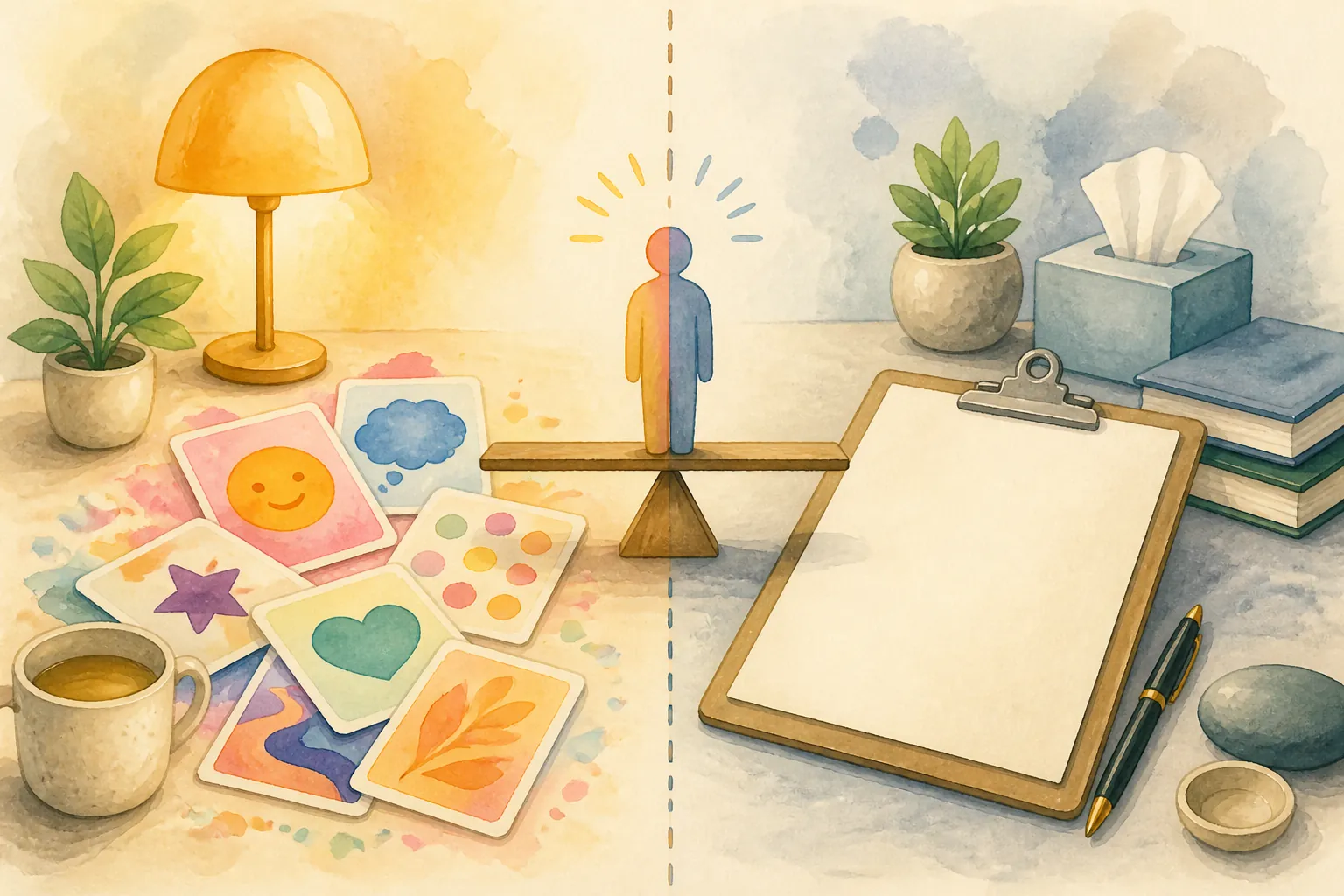
A quiz tells you you're an INFP. A clinician tells you you have generalized anxiety disorder. Both results arrive on a screen with text on them, both use the language of psychology, and both can feel like an explanation of your insides. They are very different things.
Most people sense the difference intuitively, but the difference itself often goes un-named, and that is where the trouble starts. A quiz result becomes a diagnosis in your head when you weren't planning for it to. A real diagnostic moment gets shrugged off because it arrived in a casual-feeling format. The line is worth drawing carefully, both for your own use of personality content and for thinking clearly when the more serious kind shows up.
This piece is a plain-language walk through that line. What a quiz actually is. What a clinical assessment actually is. Why they live in different lanes. And how to enjoy the lighter content without accidentally treating it as medicine.
What an online personality quiz is
The online quiz you take on Selvora — or anywhere else — is a pattern-matcher dressed up in scenarios. You answer a series of questions. Each answer adds points to one or more result archetypes. At the end, the archetype with the most points becomes your result. That's the entire engine.
The craft a good quiz brings to that engine is real. Scenario writing matters. Answer-option phrasing matters. The way result descriptions handle overlap matters. A well-made quiz produces results that feel resonant because the writer knew how to picture a real human inside the scenarios. None of this is shameful or fake. It's a creative and useful tradition, and it descends, sometimes loosely, from real psychology.
But the quiz is not measuring your psyche the way a thermometer measures heat. It's reading the surface of the choices you happened to make today and reflecting back a tidy picture of one possible pattern. If you took the same quiz two months from now with a different mood and a different week behind you, you might get a different result. That doesn't make the quiz broken. It makes the quiz exactly what it is: a snapshot of how you described yourself in the past ten minutes, formatted as a small character study.
The right consumer relationship with that artifact is the same as your relationship with a good novel, a good astrology column, or a long conversation with a friend who's slightly too willing to analyze you. You can take it home. You can quote it. You shouldn't treat it as a medical chart.
What a clinical diagnostic assessment actually is
Now contrast that with what a clinician does when they assess a patient.
Diagnostic assessments in mental health are built on a much heavier scaffolding. They draw on diagnostic manuals (the DSM-5 in most of the world, the ICD-11 internationally) that describe the criteria for each condition with explicit symptom counts, duration requirements, and exclusion clauses. "Two-plus weeks of depressed mood most of the day, nearly every day, with five or more specific symptoms" is what major depressive disorder looks like in the manual. The phrasing isn't poetic; it's deliberately tight, so two different clinicians can apply it to the same case and arrive at similar conclusions.
The actual assessment process is usually multi-modal. A clinical interview gathers history. Validated structured instruments such as the PHQ-9 for depression, the GAD-7 for anxiety, the ADOS for autism spectrum, and the MMPI for broader personality and psychopathology provide quantified data with documented reliability and validity. The clinician integrates the instruments with the history, with their direct observation, sometimes with collateral information from family or other providers, and they exercise clinical judgment that comes from years of supervised training.
The instruments themselves are not handed out as quizzes. The PHQ-9 looks deceptively simple — nine questions — but its psychometric properties have been studied in tens of thousands of cases. Its scoring bands are calibrated against actual clinical outcomes. Its administration usually happens in a context where the responses can be followed up: "You scored a 6 on item 9. Can you tell me more about that?"
None of this matches what an online quiz can do. The quiz can't ask follow-up questions. It can't observe your face. It doesn't have your history. It hasn't been trained for hundreds of hours under supervision. Its scoring isn't validated against medical outcomes. It is, on a fundamental level, a different kind of object.
Why the difference matters
A few specific reasons.
A diagnostic instrument has consequences attached. A real assessment can change what treatment is offered, what medication is considered, what accommodations are granted at school or work, what insurance covers. The weight of those consequences is exactly why clinicians spend years learning how to assess responsibly. A quiz result that announces "you're an INFP" doesn't carry that weight. "You have ADHD" on a casual quiz can carry it accidentally, and that's where harm starts.
Self-diagnosis from a quiz risks two opposite mistakes. The first is over-diagnosis: concluding from a checklist that you have a condition you don't actually meet criteria for, building an identity around it, and shaping decisions on that scaffold. The second is under-diagnosis: taking a quiz, getting a reassuring "you're fine" result, and not pursuing a real conversation about something that actually warrants one. Both errors come from treating a quiz as a diagnostic tool when it isn't one.
The skill of a clinician is mostly invisible to a quiz. A good clinician notices the things you didn't say. They notice the gap between how you describe your sleep and how exhausted you look. They notice when an answer is delivered too quickly or too carefully. They distinguish between two presentations that would score the same on a written instrument. None of that is available to a static online form. The instrument is part of the assessment, not the assessment itself.
Clinical conditions have a lot of overlap and a lot of nuance. Anxiety and depression share many symptoms. ADHD and trauma can look similar. Autistic burnout and depression can be confused for each other, especially in adults assessed late. Bipolar II is routinely missed because the hypomania doesn't feel like a problem to the person experiencing it. The differential is the actual job. A quiz can't do differential diagnosis; it can only score the answers you gave to the questions it asked.
This is why responsible online quiz content stops short of using clinical terminology as if it were a result. "Your attachment style leans anxious" is a defensible reflection statement. "You have attachment disorder" is not, and serious online content avoids the second framing.
What the quiz is genuinely doing for you
The right way to read this isn't "online quizzes are useless because they're not clinical." That's a category error in the opposite direction. A novel isn't worse than a medical chart; it's a different thing for a different purpose. Online quizzes earn their place in your life if you read them as what they are.
They hand you language. "Sometimes I withdraw when I'm overwhelmed" is a thing you might know about yourself without ever having said it out loud. A quiz that names that pattern is doing real work.
They open conversations. Couples, friends, family members all talk a little differently when there's a shared vocabulary, even an imperfect one, for differences they were trying to name.
They prompt useful self-reflection. "This result says I avoid conflict. Is that actually true?" is exactly the kind of question that produces growth when you sit with it for a week.
They provide pleasure. There's no shame in liking a quiz the way you'd like a horoscope or a meme. Pleasure is part of the human menu, and personality content provides it cleanly when it's used at the right altitude.
None of these uses require the quiz to be diagnostic. In fact, treating the quiz as diagnostic is what makes it stop being good at the things it's actually good at.
When the quiz brushes against something heavier
Sometimes you take a casual quiz and a result line hits unexpectedly hard. "You tend to feel that no one really knows you." You read it twice. You feel a little sick. A small voice inside says that's been true for years and I never named it.
That moment is real, and it's worth honoring. But the next step is not to take three more quizzes that all confirm the feeling. The next step, if the feeling persists, is to talk to a human being trained to help with feelings that big. That might be a therapist, a counselor, a doctor who can refer you, or in some countries a community mental-health line that triages and points you toward affordable help.
The quiz did its real job in that moment: it surfaced something you didn't have words for. Now the work belongs to a different kind of conversation. Quizzes are good at naming. They are not built for holding.
This is also why every quiz on Selvora that touches a psychology-adjacent topic (attachment, emotional intelligence, stress coping) explicitly says somewhere on the page that the result is for reflection, not for clinical use, and points to professional help when relevant. We will not stop saying that, because it is genuinely the most important sentence on those pages.
A short checklist for keeping the line clear
A few practical moves to keep yourself in the right relationship with personality content.
Ask what consequences you'd attach to the result. If you're about to quit a job, end a relationship, refuse a treatment, or drop a class based on a quiz result, slow down. The result was not built for that weight. The decision is allowed; the quiz being the deciding voice is the part to question.
Notice when you're reaching for clinical words. If you read a quiz result and the sentence in your head shifts from "this describes a pattern" to "I have a disorder," take a step back. The shift from descriptive to diagnostic is the shift the content can't earn for you. A real diagnosis is a different conversation.
Treat the quiz as a starting hypothesis, not a closing argument. If a result resonates, carry the most striking line through your week and look for it. If it keeps proving true and the topic feels weighty, that's a reason to bring it to someone qualified, not a reason to take more quizzes.
Take the lighter quizzes lightly. A "what color is your aura" quiz is not in the same category as an attachment-style quiz. The first is play; the second is reflection-with-some-real-content-underneath. Both are fine. They are different fines.
Use your support network. Friends and family who know you are often better mirrors than any quiz. A casual quiz can suggest "you might be conflict-averse," but the friend who actually saw you go quiet at brunch last weekend has data the quiz doesn't.
A note on language Selvora avoids
We write our quizzes to avoid certain phrasings on purpose. We don't tell you that your result "diagnoses" anything. We try not to use the phrase "are you X?" in a way that implies a yes-or-no clinical answer. When a quiz is inspired by a framework with any clinical lineage, like attachment or emotional intelligence, the intro paragraph says clearly that the content is for reflection, not assessment. The result page does the same. We do this because the alternative — "sounds clinical, looks clinical, is treated by the reader as clinical" — is exactly the failure mode this whole piece is about.
It's an editorial choice, and we make it because we want Selvora to be a place where personality content stays in the lane it does well. Fun. Reflective. Honest about what it can carry.
The one-line summary for the article: a personality quiz is a sketch, a diagnosis is a treatment plan; enjoy the sketch, and trust the treatment to people trained to draw it.
Some of the frameworks here are well-researched, some are mostly tradition. The books and studies behind each one — and how solid each is — are listed in our editorial sources.
More from this hub
Personality Type Stereotypes Worth Letting Go
Personality memes are fun until they flatten real people. The stereotypes that keep recurring across MBTI, Enneagram, and zodiac content — and why each one is weaker than it looks.
What Makes Online Quizzes Feel So Accurate?
The jaw-drop moment when a quiz "sees" you isn't magic. A walk through the craft behind accurate-feeling quizzes — scenario questions, overlapping descriptions, the Barnum effect — and what separates a good quiz from a clever trick.
A Beginner's Map of Online Personality Frameworks
A calm tour of the frameworks you keep meeting online — MBTI, the Big Five, Enneagram, attachment theory, love languages, zodiac — with a plain-language take on what each is, where it's useful, and where it gets oversold.