Should You Take a Personality Quiz When You're Moody?
Mood bleeds into every answer you give. Here's how to read a personality quiz result without mistaking a bad Tuesday for a permanent identity.
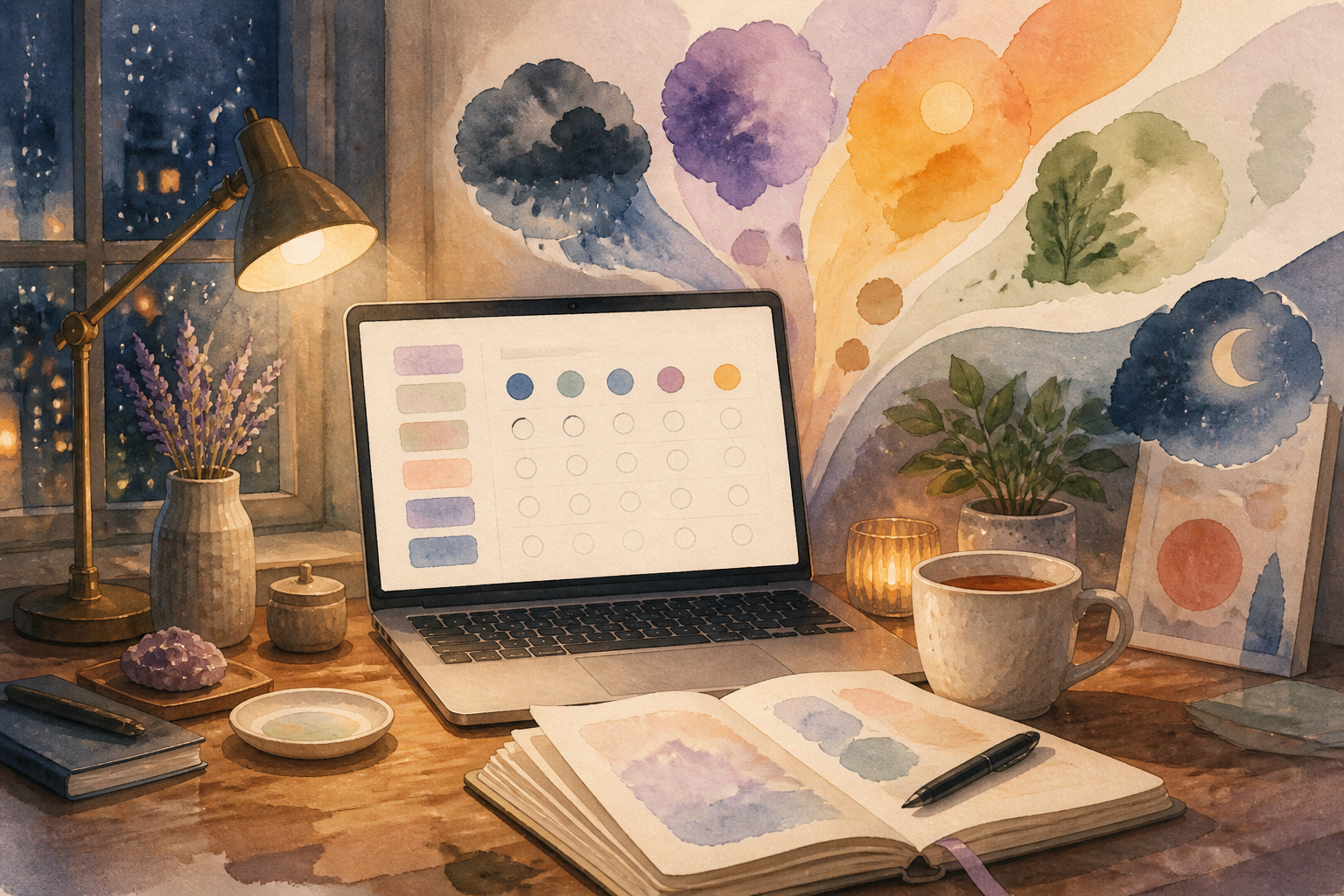
You already suspected this
You opened a quiz at 11pm after a long day. You answered "strongly disagree" to almost every question with the word socializing in it. The result told you you were the most reclusive type on the chart, and for a moment it felt true. The next afternoon, on the way back from a coffee with a friend, the same description felt like a stranger's coat.
Which one was the real you?
This is the most ordinary question you can ask about a personality test, and most quiz pages avoid it. So here is the honest version of the answer: a personality quiz is much closer to a snapshot of how you feel today than it is to a portrait of who you are.
That is not a flaw. It just changes what the result is good for.
What mood does to your answers
Quiz researchers have a useful word for this: state vs trait. A trait is a stable tendency over months and years. A state is what is going on inside you right now — your energy, your worries, your sleep last night, the conversation you just had. Most online personality quizzes ask you to introspect, and introspection is a state-loaded operation. The answer you give is shaped by the mood you carry into the question.
A few common ways mood bleeds in:
- Tiredness reads as introversion. When your battery is low, every social-energy question reads like "would you rather lie down?" The honest answer at that moment is yes, even for someone who would normally pick the social option.
- Recent conflict reads as low agreeableness. If you took the quiz an hour after an argument, you will rate yourself as colder and more skeptical of people than the version of you that took the same test on Sunday morning.
- A productive week reads as conscientiousness. Two weeks of hitting your goals and you suddenly score higher on "organized," "reliable," "finishes what they start." Two weeks of doomscrolling and the same trait reads lower.
- Recent kindness from someone reads as openness. If a stranger was nice to you on the train, you will pick more curious, more outward-facing answers for the next twenty minutes.
None of these are bugs in you. They are how state-loaded questions work.
The good news
The noise also has structure. If you take the same quiz five times across two weeks and get five mildly different results, the quiz is showing you the range you live in, not five contradictory selves. That range is real information.
A person whose attachment-style result oscillates between secure and anxious across moods is genuinely a different person from someone whose result oscillates between secure and avoidant. The variance, not the single result, is the data.
This is why "I got X today, but Y last month" is not a contradiction. It is a richer answer to the question who am I than any single result can give.
When to retake
Some practical rules of thumb that have held up well for us:
Take it once when you are basically okay, not when you are crying. Crying is real, but a quiz built for the median day will misread an unusually hard day as a permanent setting. If today is a hard day, save the quiz for the weekend.
Avoid taking a quiz right after the topic. A romantic-style quiz the night of a fight reads the fight, not the relationship. A career-style quiz on Sunday at 11pm reads dread of Monday, not your career.
Do retake it after a meaningful change. New job, new partner, six months of therapy, a year of consistent sleep — these are the moments where a retake is genuinely informative, because the underlying state has shifted.
Compare the agreement, not just the headline. If your last three results all included the same one or two phrases, those phrases are the part to trust. If a phrase only showed up once, treat it as moody noise.
How to read the result you have right now
When the result is in front of you, do three small things before deciding whether to keep it.
First, read it out loud. Sentences that sound like you when you hear them have a different texture from sentences that only look right on screen. Reading aloud is a cheap honesty filter.
Second, ask one specific person who knows you well to read the description. Not to bless it — to disagree with it. Ask them to point at one line that does not sound like you. The lines they push back on are usually the lines mood wrote, not your trait.
Third, notice your own resistance. If a sentence makes you want to argue, stay with that for a moment before clicking away. The reaction no, I'm not like that is sometimes a person genuinely being misread, and sometimes a person bumping into a true thing they did not want to see. Telling which is which is most of the work.
What to do with the result
The healthiest move with any quiz result, especially one taken in a mood, is to give it a one-week tour.
Pick the single sentence in the result that landed hardest. Carry it as a hypothesis through the next seven days. Watch for the moments when it is obviously true. Watch for the moments when it is obviously false. Both kinds of moments are useful. By the end of the week you will have replaced the quiz's interpretation with your own much richer one.
This is also why the most useful quiz on Selvora is not necessarily the one you take first. It is the one whose result you remember a month later because it changed how you noticed your own week.
A small disclaimer for the heavy days
If today is genuinely heavy — not a bad afternoon but a stretch of weeks where things have felt off — a personality quiz is the wrong tool for that, and we say so on every relevant page. A quiz is not a diagnostic instrument, and a conversation with a licensed professional will help more than any sketch we can draw. Selvora's quizzes are made for ordinary days; for the heavier ones, please look after yourself.
And on an ordinary day: take the quiz, take the result with both hands, then loosen the grip. The point of a sketch is that you can sketch over it.
Some of the frameworks here are well-researched, some are mostly tradition. The books and studies behind each one — and how solid each is — are listed in our editorial sources.
More from this hub
What Makes Online Quizzes Feel So Accurate?
The jaw-drop moment when a quiz "sees" you isn't magic. A walk through the craft behind accurate-feeling quizzes — scenario questions, overlapping descriptions, the Barnum effect — and what separates a good quiz from a clever trick.
A Beginner's Map of Online Personality Frameworks
A calm tour of the frameworks you keep meeting online — MBTI, the Big Five, Enneagram, attachment theory, love languages, zodiac — with a plain-language take on what each is, where it's useful, and where it gets oversold.
I Make Personality Quizzes. I Don't Believe in Personality Types.
The person who makes the quizzes, on what these tests actually do — the 1949 Forer experiment, why a result feels accurate, and how to use one without mistaking it for a diagnosis.