
Your result
Your Attachment Style is Avoidant!
You're the one who cries in the parked car after ending the thing you ended — and then walks back inside with a steady face like nothing happened.

What this means
You're the one who cries in the parked car after ending the thing you ended — and then walks back inside with a steady face like nothing happened. That gap between what moves under the surface and what you let anyone see is the whole story of avoidant attachment. You built a fortress early, and you built it well, because somewhere back there leaning on people turned out to be a bad bet. The lesson stuck: the only person guaranteed not to let you down is you. So you got self-sufficient, low-maintenance, hard to rattle. From outside you look like someone who has it handled. That's exactly the problem.
The world loves to call your style cold, and that's a lazy read. You don't feel less. If anything you feel a lot, which is precisely why you learned to put it behind glass — feelings that big needed somewhere managed to live. So you intellectualize, process alone at 2am, and show up the next morning fully composed. You're the person who misses someone with a physical ache and would sooner walk into the sea than say it out loud. Need, in your system, reads as exposure. Exposure reads as risk.
The real strength here is a sovereignty most people never reach. You can be alone without falling apart, and you don't outsource your stability to whoever you're dating. You think clearly in moments that flatten other people, and you can sit with a hard decision without needing a committee to approve your feelings first. People trust your steadiness in a crisis precisely because you're not drowning in it.
The shadow is that the wall can't tell a threat from a person who loves you. It blocks both. When someone gets close enough to actually matter, your nervous system reads it as a fire alarm and you reach for distance — pick a flaw, find them suddenly too much, get busy, go quiet. You can dismantle something genuinely good because keeping it would require the one thing the fortress was built to prevent: being seen without armor. And the relief you feel when a partner finally backs off is the tell.
Up close, this looks like drifting instead of deciding, and questions about feelings answered with logistics. From a step further back it reads as capability no one ever gets behind: admired, relied on, rarely known.
On a stressful Tuesday, honestly, this style earns its keep. The server is down, two people are panicking, and you go quiet and fix it. You decline help, not out of pride exactly, but because explaining the problem feels more expensive than solving it. Someone asks how you're doing and gets "busy," which is accurate and also a door easing shut. The group chat? You read everything and post almost nothing. A thumbs-up lands on a three-day-old message, and that, in your dialect, is warmth.
Family dinner runs the same protocol. You show up, you're pleasant, and you picked your departure time before your coat was off. Questions about your life get the press-release version: work's fine, all good. Your self-talk is a manager's voice, handled, fine, next, and it really does keep you moving. The cost is quieter and arrives later, as the odd loneliness of being the person nobody ever worries about. People assume you have people. Small experiment: once a week, give one honest answer to one safe person's "how are you," then notice that nothing collapses. The composed version of you survived all these years. Turns out the uncomposed one does too.
The growth edge isn't tearing the walls down in one dramatic afternoon. It's letting one safe person past them, on purpose, in small doses — saying the thing you'd normally swallow, staying thirty seconds longer than is comfortable. The fortress kept a younger you alive and it deserves your gratitude. But it's now keeping out the exact closeness you quietly go hungry for. The right people aren't the ones who accept your distance forever. They're the ones who make nearness feel safe enough that, eventually, you stop needing the wall at all.
Key traits
Best paired with
Secure
How to read this result
A closer look at the "Your Attachment Style is Avoidant!" outcome of What's Your Attachment Style? — whether you just took the test or found this page from search.
Read it as a sketch of one answer pattern, not a fixed identity. Mood and timing move results like this more than people expect, so if a line lands, check it against a real week before you build anything on it.
Questions for reflection
- 1.Which line in the "Your Attachment Style is Avoidant!" description felt most like you this week, and which one missed?
- 2.When did "Radical Self-Reliance" last show up in a real situation, and did it help or get in the way?
- 3.If you took the same test on two very different days, which answers do you think would shift?
It is fine if no answer comes to mind right away. These are prompts, not verdicts.
Selvora results are entertainment for self-reflection and conversation. They are not mental-health, medical, legal, or financial advice — for decisions like those, please talk to a qualified professional.
Tomorrow's card
Tomorrow's card is already chosen — it just stays face-down until midnight.
Related reading
How to Set Boundaries Without Feeling Like the Villain
A boundary is a statement about your own behavior, not control of someone else's. Why it feels like betrayal, where the guilt comes from, plus scripts that work.
Learn MoreBurnout Recovery: What Actually Refills the Tank (and What Just Looks Like Rest)
Why a weekend off doesn't fix burnout, how passive numbing differs from real recovery, and how to match rest to the kind of depletion you're actually running on.
Learn MoreGo deeper — guide essays
Longer reads on how to use this result without locking yourself into a label — and where the framework actually stops being useful.
The Big Five, Without the Jargon
Five sliders instead of sixteen boxes. Why researchers trust the Big Five, what each trait looks like at the coffee machine, and where it quietly stops.
GuideEmotional Intelligence Is Four Muscles, Not One Gift
EQ isn't a trait you have or lack. It's four trainable skills, and they show up in the most ordinary moments of your week.
GuideAttachment Doesn't Only Happen in Bed: Patterns at Work, with Friends, and as a Parent
The four attachment patterns shape your group chat and your inbox, not just dating. A look beyond romance, and why a result is a snapshot, not a sentence.
Try Another
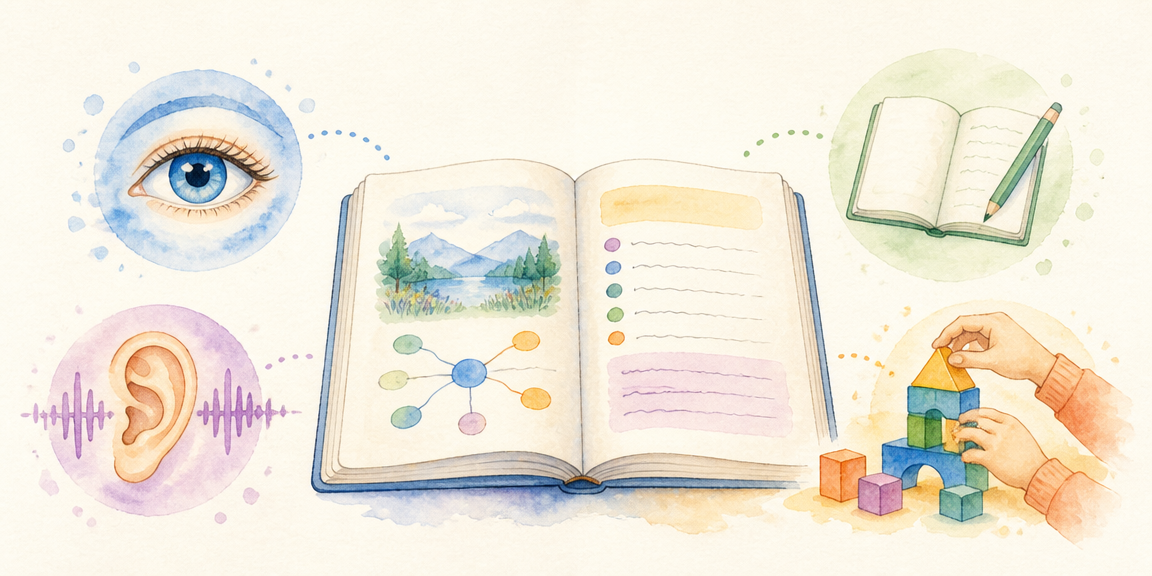
What's Your Learning Style? 📚✨
A playful look at how your brain prefers to take in new information — pictures, voices, written words, or hands-on practice. Use it as a starting point for studying smarter, not as a rigid label.
Start Quiz
What Kind of Friend Are You? 💛
A warm reflection on what you bring into a friendship — energy, listening, adventure, or the kind of loyalty that doesn't go anywhere. Tag your best friend at the end and find out theirs too.
Start Quiz
What's Your EQ Style? 🧠💛
A playful reflection on the four emotional-intelligence muscles you naturally lean on — noticing feelings, managing them, reading other people, or connecting with them. For entertainment and self-reflection, not a clinical EQ test.
Start Quiz
How Do You Handle Stress? 🌊
A reflection on the moves you reach for when pressure hits — fixing the problem, soothing the feeling, calling for backup, or shifting the meaning. Use it to spot your default and add the moves you're missing. Not a clinical assessment.
Start Quiz