What's Your Learning Style? 📚✨
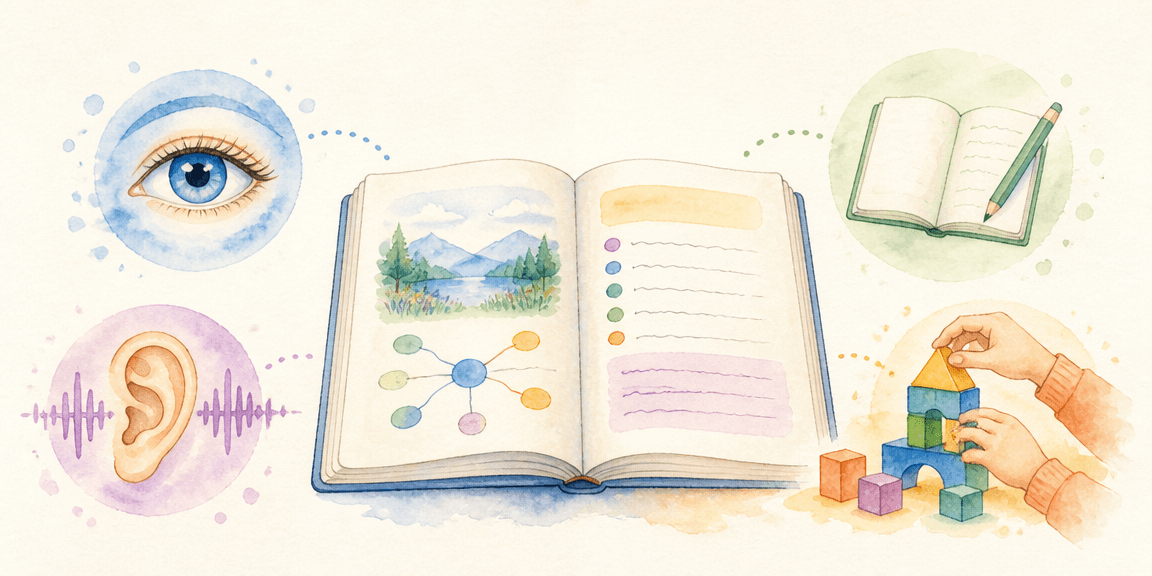
A playful look at how your brain prefers to take in new information — pictures, voices, written words, or hands-on practice. Use it as a starting point for studying smarter, not as a rigid label.
No sign-up required. Your answers aren't stored anywhere.
What this quiz is
A learning-style quiz built on the familiar VARK idea — that people lean toward taking in new information through pictures, sound, written words, or hands-on practice. Your answers sort you toward Visual, Auditory, Reading-Writing, or Kinesthetic, and the result is meant as a study-strategy starting point. Worth knowing: the "match the teaching to your style and you'll learn better" claim isn't well supported by research, so treat your result as one preference to experiment with — not a fixed label or a reason to avoid other methods.
How to use your result
Don't hunt for a job title in the result — look for the textures it names: pace, autonomy, the kind of day that leaves you full instead of drained. Then test one of those textures against your actual week before letting it near any bigger decision.
Wherever the result and your actual experience disagree, your experience outranks it.
How results work on SelvoraHow this test was designed
- What it measures
- Which work-style and daily-texture-of-work themes your answers gravitate toward — pace, structure, autonomy, people-density, the kind of output that feels satisfying — rather than a specific job title. The result is a sketch of "days that energize you" mapped onto a few career themes you could put alongside your real-world experience.
- Why these questions
- Items ask about the texture of your ideal day — what you'd want first thing in the morning, what kind of meeting drains vs. recharges you, what kind of feedback you find motivating — because that texture is, in practice, the most under-asked and most predictive question in career advice. Specific job titles tend to be downstream of these textures.
- How the result is divided
- Each answer adds points to multiple career themes (e.g., "deep maker work," "high-people coordination," "structured analytical"), and the top one or two themes form the result. We deliberately don't output a single job title — naming "product manager" or "therapist" as your destiny from a 10-minute quiz would be a small, recurring disservice.
- Please do not
- Do not use this result to drop a class, quit a job, or skip a career conversation with someone who actually knows the field. The quiz can suggest themes worth exploring; real-world experimentation — internships, side projects, talking to people doing the work — is the actual evidence.
What this quiz can help with
- •Point to which input channel — visual, auditory, reading-writing, or hands-on — you tend to reach for first.
- •Suggest concrete study tweaks to try this week, like diagramming, talking it out, rewriting notes, or building something.
- •Start a useful conversation with a study partner about how you each absorb material differently.
What this quiz cannot do
- •Prove that you only learn one way — most people mix channels depending on the subject.
- •Predict your grades, your intelligence, or how a class will go.
- •Replace simply testing what actually helps you remember and understand.
Related reading
Leadership Styles in Plain Language
The seven leadership styles you keep hearing about, each with a quick scene, an honest shadow side, and the one idea that matters: the good ones switch.
How Career-Fit Quizzes Actually Sort You
Holland Codes (RIASEC), strengths frameworks, and why "what job should I do?" is the wrong question. How to read a career result as one input, not destiny.
Build a Work Life Around the Texture of Your Days
Stop hunting for the perfect job title. Map your ideal Tuesday, track what gives and drains energy, and run cheap real-world experiments over any test.