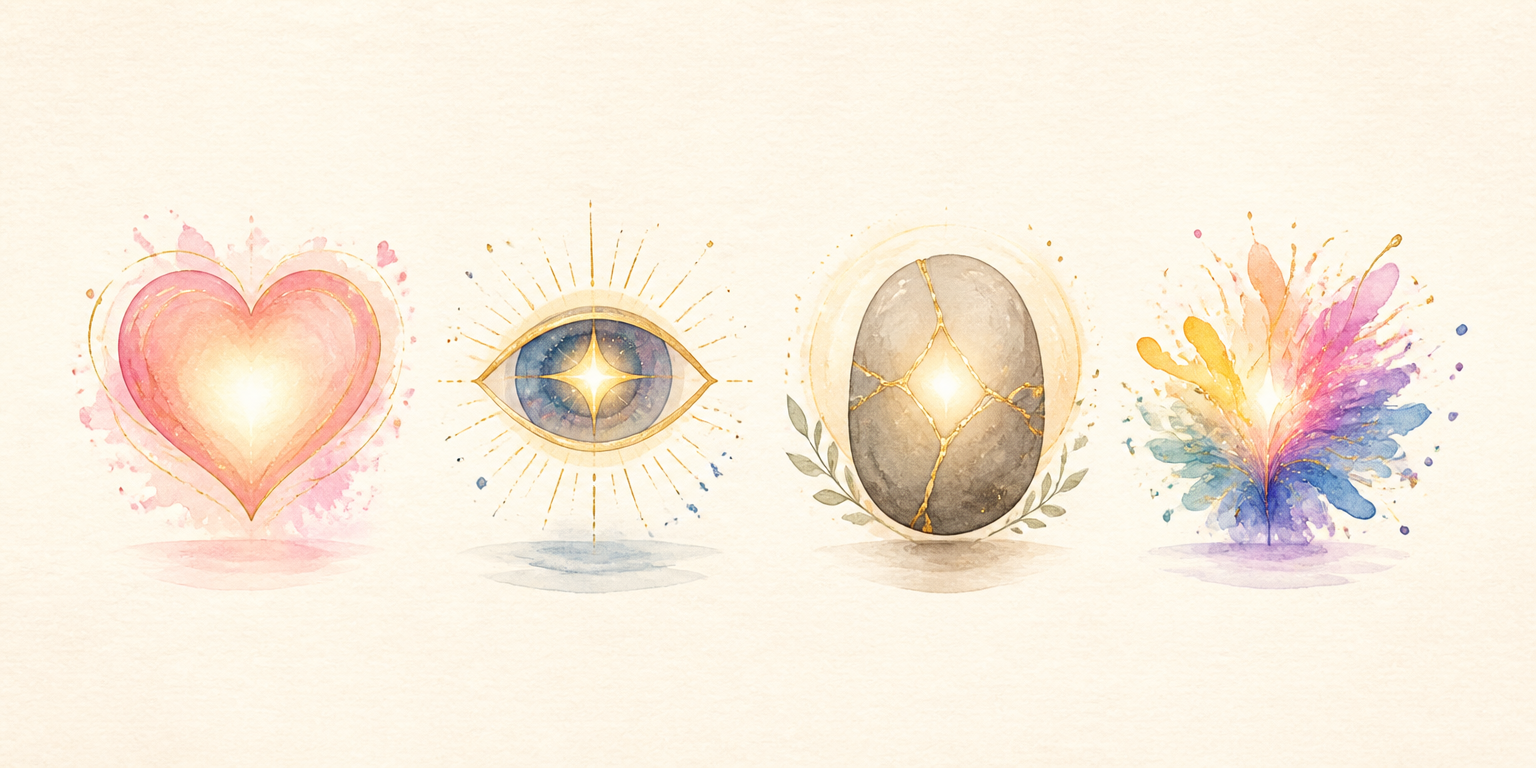
The 4 Secret Superpowers — Empathy, Intuition, Resilience, Creativity (and the Shadow Each One Casts)
Empathy, intuition, resilience, creativity — what each looks like on a normal day, the trap it quietly sets, and how to lean on it well.
Monday morning, office elevator. A coworker says "morning" the way they always do — and one person catches, in that half-second of tone, that something is off with them today. Another person opens the meeting deck and just *sees* that the conclusion is wrong, before they can explain why. Same elevator, different antenna lighting up.
In superhero movies the powers are always loud. Fire from the hands, time freezing, flight. Real-life superpowers are much quieter. They hide inside an ordinary Tuesday, and the person who has one usually shrugs it off as "that's just me." This is about the four quiet ones: empathy, intuition, resilience, and creativity. And like every power in every good origin story, each one drags a shadow behind it. The stronger the gift, the longer the shadow — which is a little unfair, honestly.
Read this like an origin story, not like a strengths report you'd hand to a hiring manager.
🫂 Empathy — Reading the Room's Temperature on Entry
The empath's power is sensing. A friend says "I'm fine," and the empath hears that the "fine" weighs more than it usually does. They feel a group chat go subtly cold before anyone else notices. At a party, they're the one who clocks the person hovering alone at the edge and goes to sit by them. To the empath it feels obvious — "can't you all see it?" — but no, most people can't.
On an ordinary day this looks like: a coworker is poking at their lunch in silence, and "hey, what's going on?" comes out automatically. They hear three seconds of a parent's voice on the phone and ask "are you not feeling well?" They're the friend everyone describes as "so easy to talk to," the one people end up telling their real stuff to without quite planning to.
Here's the trap. Empaths don't just sense feelings — they *absorb* them. A friend offloads something heavy, walks away lighter, and the empath carries that weight home. Do that for three people in a day and by evening you're drained for no reason you can name. The dangerous part is when you can't tell which feelings are yours and which ones you picked up from someone else. That confusion is the front door of burnout. When an empath thinks "why do I get tired so easily?" — usually they're not weak, they've just been carrying too many people at once.
Leaning on it well is simple to say and hard to do: separate sensing from carrying. Noticing your friend's sadness does not mean you're now responsible for fixing it. "I see that you're hurting" is empathy. "So I'll take all of this on myself" is absorption, and they are not the same move. And once in a while, ask yourself an honest question: "I'm always the one listening — who listens to me?" A mirror that only ever reflects other people eventually needs someone to reflect it back. You're allowed to lean too.
🔮 Intuition — Already Knowing the Answer You Can't Explain
The intuitive arrives at the conclusion first. Three interviewers love a candidate, and the intuitive quietly thinks "something's not right with this one" — and three months later, there it is. They take the other route home for no reason and it turns out to be the right call. When someone lies, the content matters less than the "hm, that doesn't add up" that lights up before the sentence is even finished. They see the pattern before the data is all in.
On an ordinary day: a friend is glowing about a new relationship, and the intuitive's face goes slightly funny after hearing about only the second date. The whole team wants Option A, and the intuitive has a clear, wordless certainty that B is correct. Annoyingly often, B was correct.
The trap is right there. Intuitives skip the explaining step. In their head, A connects to Z through every letter in between — but they only hand other people the Z. "It's just right, trust me." From the outside, with no reasoning attached, that's not convincing. So the intuitive gets frustrated, the other person thinks "why do you always do whatever you want," and they drift. The read was correct, and the intuitive loses the person anyway. Brilliant judgment keeps getting filed under "stubborn."
Using it well means treating reaching the answer and getting people to walk there with you as two separate jobs. When intuition says "go this way," don't stop there. Ask yourself one more thing: "why did I feel that?" and surface at least one or two reasons out loud. Intuition is really compressed experience — a fast-processed file — and when you unzip it, there's evidence inside. Show people that evidence, and the genius stops being a loner. Honestly, this one habit fixes most of the friction.
🪨 Resilience — Falls Down, Shows Up to Work Anyway
Resilient people are geniuses at getting back up. Something blows up, and "okay, what can you do, you just deal with it" comes fast. They fail the exam and have a new plan within three days. They get dumped and somehow still make it to work. A family crisis hits and they quietly handle their part of it. They're the person everyone calls "so solid." Composure is their default in a crisis, which is exactly why people lean on them.
On an ordinary day: they keep the plans even when they feel terrible. A project collapses and they move to "fine, let's do it this way" almost immediately. They rarely say they're struggling. The to-do list is long and they just keep crossing things off, one by one. From the outside they look unshakeable.
But the deepest trap of all four lives here. Resilient people will not ask for help. "I've got it handled" is buried so deep that even in genuinely hard moments, they don't reach out. They don't want to be a burden, don't want to look weak, and honestly the scariest thing is admitting "I can't do this alone." So they carry everything solo until one day they break down over something tiny. People around them go "what's gotten into them?" — but really, several months just came due all at once. The person who looks the most solid is very often the loneliest one in the room.
Leaning on it well is a bit paradoxical: redefine asking for help as part of resilience, not a failure of it. Holding everything alone isn't strength — being able to say "I'm struggling" when you need to is the stronger move. Practice small. When someone offers "can I help?", don't reflex straight into "no, I'm fine." Once in a while, take it: "actually, yeah, could you grab this part?" Solid doesn't mean carrying it all. It means knowing how to split the weight. If you never learn to put a load down, the load eventually crushes the one carrying it.
🎨 Creativity — A Universe in Their Head, a Desk of Unfinished Drafts
Creative people are geniuses at connection. They link things nobody else links. "What if you combined this with that?" arrives mid-shower out of nowhere. In a meeting they throw out an angle no one considered, and they look at a boring problem and naturally wonder "but what if we did it completely differently?" Their head is always running loud. They have never, not once, been short on ideas.
On an ordinary day: they lie down to sleep and a brand-new project blueprint unfolds behind their eyes. Their laptop has twelve folders that were started and abandoned. The notes app is stuffed with shimmering ideas, and the count of things that reached the finish line fits on one hand. Starting is electric. By the boring 80% of finishing, the next idea is already shinier.
That's exactly the trap. Creative people can't finish. The thrill of starting is their fuel, and finishing has no thrill in it. Polishing details, grinding through the dull revisions, reworking something you've already "seen" a hundred times — that's the stretch where the heart cools off. So brilliant ideas pile up as folders frozen forever at 80%. The world doesn't get to see the 90%-finished work of a genius; it sees the 100%-finished work of an ordinary person. If you never cross the line, nobody sees the universe. It stays a private museum, and you're the only visitor.
Using it well means building a separate "finishing system" on purpose. You already have plenty of creativity, so you have to deliberately borrow the finishing muscle you're short on. Put the deadline outside yourself — promise a specific person "I'll show you this on Friday." Make a rule that no new project starts until the last one ships. Swap "perfect" for "out the door," because a flawed thing that exists beats a flawless thing that doesn't. With nothing finished, all those ideas live only in the museum in your head — and the only ticket holder is you.
✨ When the Four Mix Inside One Person
You may have read this far thinking "but I'm both empathy and intuition?" Right — most people have one main power with the others mixed in at lower volume. Almost nobody is one pure type, and that's a good thing, actually. An empath with a little intuition reads people more accurately. A creative who can borrow some resilience ends up with fewer abandoned folders.
The interesting bit: each power's shadow is usually patched by the opposite power. The empath's burnout eases with the resilient person's "keep a healthy distance." The intuitive's communication breakdown loosens up with the creative's "explain it a different way." So rather than only sharpening your main gift, growing your weakest square by even a notch is what actually balances you out.
Knowing your main superpower means knowing, at the same time, what you're automatically great at and what trap you automatically fall into. Use the gift more boldly, dodge the trap earlier. That's the next chapter of the origin story.

🦸 So What's Yours?
A quick 10-question quiz can give you a read on your main power. Take the secret superpower test to find out which antenna lights up first in you. Send your result to a friend afterward, too — you might discover that your shadow has quietly been covered by their gift all along.
If you want to read more about personality and strengths, there are pieces collected in the personality guide hub, and the full guides library if you want to wander into other topics.
Note: This is an origin story for fun and self-understanding — not a strengths report for a job interview, and not a clinical assessment. People light up different powers in different seasons, so don't lock yourself into one label. Use it more like a mirror for asking "what's shining brightest in me right now?"
Related picks
This section may contain Coupang Partners affiliate links. We may earn a commission from qualifying purchases.
성격 심리 책
자기이해 워크북
무지 노트
Try This Quiz
Taking the quiz is even better than reading about it!
Related Articles
What 'the Era You Belong To' Actually Says About Your Values
Ancient Greece, Medieval, Renaissance, Victorian, a far-future 2150. Each era result is a portrait of your values in costume, not a past life. Who resonates with which, honestly.
Read More
The Four Kinds of Friend, and Why Every Group Needs All of Them
You can tell a friend's type by their first text after you get dumped. Cheerleader, listener, adventure buddy, guardian — plus each one's shadow side.
Read More
The 4 Friendship Types: Cheerleader, Listener, Adventurer, and Loyal Guardian
Friends bring different things to the table — energy, deep listening, adventure, and steady loyalty. A practical look at the four friendship types and how they fit together.
Read More