What 'the Era You Belong To' Actually Says About Your Values
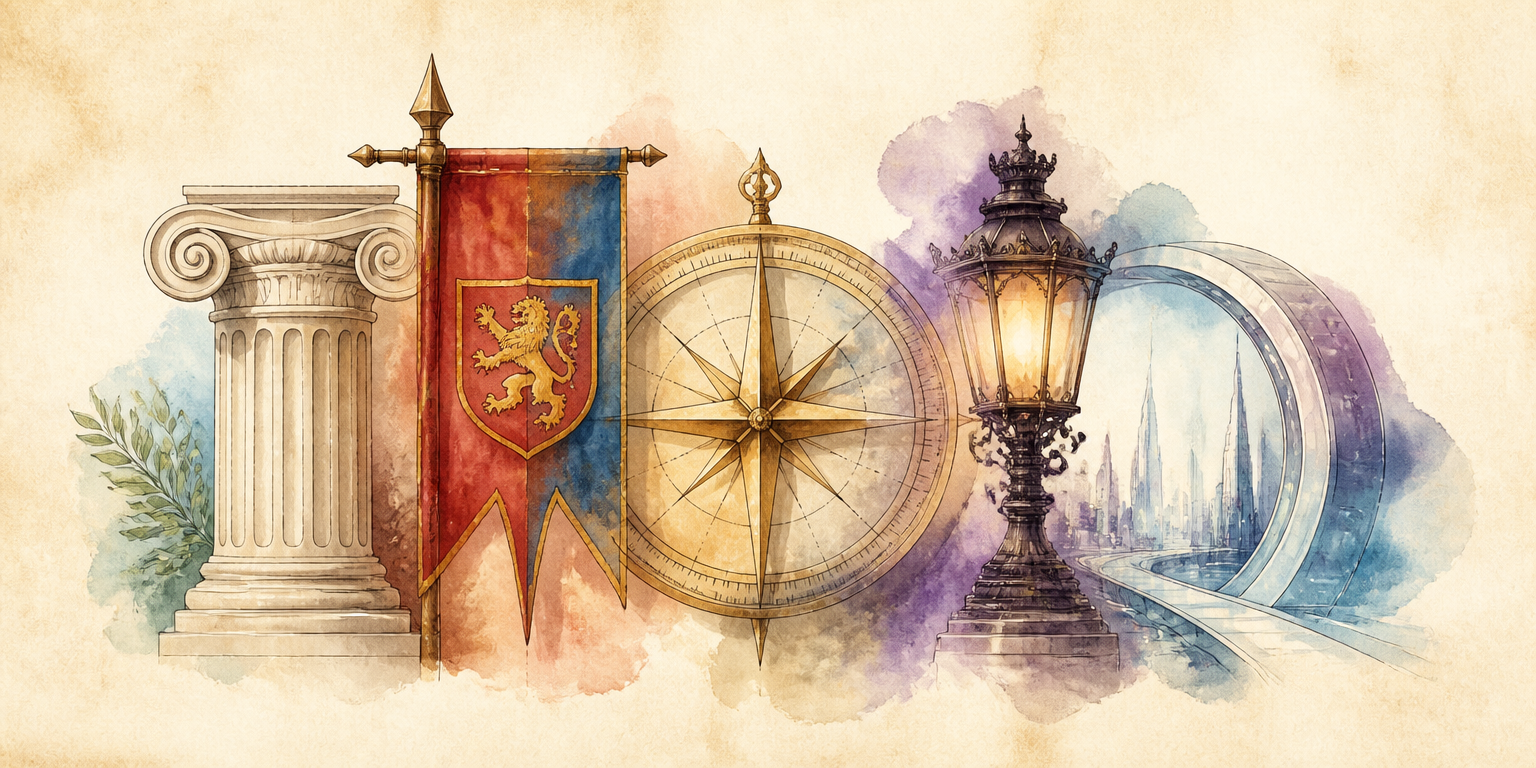
Ancient Greece, Medieval, Renaissance, Victorian, a far-future 2150. Each era result is a portrait of your values in costume, not a past life. Who resonates with which, honestly.
A friend told me they got Renaissance on the era quiz, and they were a little smug about it. So I took it too and landed on Victorian. We laughed for a while. One of us is the "start six things at once" person and the other is the "finish the thing I started or die trying" person. You can already tell which is which just from how we handle being on time for plans. The quiz just dressed that difference up in period costume and handed it back to us.
One thing worth getting straight first. An era result is not the quiz telling you that you should've been born in another century. Read it that way and it stops being fun and gets kind of weird. Here's what it actually does. Each era is a bundle of values wearing that period's clothes. The person who lives and dies by honor gets handed the medieval knight's outfit. The person who can't stop interrogating their own beliefs gets ancient Greece. So read your result as a portrait of what you value, not as a birth certificate from the past.

Ancient Greece — Can't Stop Asking 'Why'
Most people know the rough shape of the Socrates story. He went around the agora grabbing people and asking "what is justice, exactly" and "what is courage, really," annoyed enough of them that it eventually got him a cup of hemlock. If you land on ancient Greece, you've got some of that interrogating streak. You're the person for whom every answer automatically grows a follow-up: "sure, but why is that the right answer?"
This is the one in the meeting who, after everybody else is happy with the decision, says "hold on, did we even frame the question correctly?" It's annoying sometimes. You know it's annoying. You can't help it. The line about the unexamined life not being worth living isn't a quote you memorized. It's just the way you happen to live.
Translated into values: what matters most to this person is the right question, not the fast answer. Arriving at a conclusion quickly means nothing if they didn't genuinely buy the reasoning along the way. Which makes them allergic to authority, in a good way. "That's just how it's done" and "everyone does it like this" don't register as reasons. If anyone tries to win by pulling rank, the Greek type only digs in harder and asks more questions.
The weak spot is obvious. Too many questions and nothing actually moves. When a friend just wanted to vent and feel supported, and the Greek type responds with "but is that feeling even justified," that's not a conversation anymore, it's an interrogation. The thing to learn is to occasionally set the question down and just nod. Not everything needs to be cross-examined into the ground.
Medieval — Keeps the Promise All the Way Down
The medieval type runs on honor and loyalty, and those words actually mean something to them. They sound a little out of place in the present tense, sure. But these people genuinely exist. Once they decide you're "theirs," they'll take heat alongside you when you're getting torn apart, and they'll keep a promise even when it's obvious it's costing them.
Everybody has a friend like this. The one who picks up at 3 a.m. The one who, when you text "where are you" with no explanation, just shows up. The core of the medieval type is that the line between "my people" and "not my people" is drawn sharp. The boundary is clear. Unconditional with whoever's inside it, a little cold with whoever's outside.
In values terms, what matters most to this person is trust and consistency. They can't stand someone who keeps changing their story. A person who's different today than they were yesterday, who says one thing and does another, gets an almost instinctive rejection. They hold themselves to the same line, too. That's why the medieval type warms up slowly. They don't let just anyone past the wall. But once you're in, they're not letting you go without a fight.
The weak spot is when that loyalty points at the wrong thing. Clinging to a relationship that already changed, or a promise that's already over, just because "I gave my word" — that's not honor anymore, it's stubbornness. And a wall built too solid means new people can't get in at all. The medieval type sometimes needs to leave the gate cracked open on purpose.

Renaissance — Can't Stay Put on One Thing
Think about da Vinci putting down a painting halfway to fill a notebook with anatomy sketches, then drafting a flying machine, then going off to watch how water moves. The Renaissance type is exactly that. Not the person who drills deep into a single field, but the one who keeps poking at five fields at once and gets their energy from the connections between them.
This person's desk is a bit of a disaster. Five half-read books, an instrument they started learning and abandoned, tools they bought on a sudden obsession. It's not that they lack discipline — their interest just catches fire fast and jumps fast. The advice they hate most is "pick one lane and stay in it." Honestly they wonder sometimes whether they're too scattered, but living any other way feels like slow suffocation.
In values terms, what the Renaissance type hates most is a closed door. The feeling of possibilities narrowing, of being pinned down to one thing, is unbearable to them. So "one career for life" doesn't feel like stability, it feels like a cell. They're most alive when learning something new, and most thrilled when they wire together two things that looked unrelated. The person who's cooking and suddenly thinks about chemistry, or listening to music and starts seeing math in it.
The weak spot is depth. They take a lot of things to 80% and never finish. Genius at the start, soft at the end. The Renaissance type needs to practice taking one more step even after the interest has cooled, because the genuinely deep stuff usually sits just past the point where the excitement runs out. Poking around the personality guide hub is a decent way to look harder at your own pattern.
Victorian — Discipline and Leaving a Mark
The Victorian type is serious about restraint and about leaving something behind. Not in the sense of being stiff and formal, but in the sense of holding their own behavior to a steady standard and actually keeping it. The person who gets up at the same time every day, who's three years into the workout they started, who keeps a budget — like, really keeps it.
Having a friend like this around is reassuring. There's no spontaneous-bonfire excitement to them, but whatever they commit to gets done, and they don't wobble in a crisis. The Victorian type doesn't run on mood. They run on "I said I would." Not wanting to work out today and actually working out are two separate, unrelated facts in this person's life.
In values terms, what matters most is durability — the thing that lasts. Given a choice between fun right now and something that survives later, they pick later. That's why the Victorian type cares about reputation, not out of vanity but because they believe their work is what proves them. They want to leave something solid with their name on it: a career, a family, a body of work, something.
The weak spot writes itself. Too rigid and you snap. Trying to control everything means missing the unplanned joy, the happiness nobody scheduled. And when they start holding other people to their personal standard, the people living with them get tired. The Victorian type needs to practice "today, no plan, we just see" once in a while. Discipline is a tool, not the whole point of being alive.
Far-Future 2150 — Sees the System Before the People
The last one runs on a different grain. The person who lands on a far-future 2150 is looking forward, not back. Their head is full of "how do I make this thing run better." They see past the individual event to the structure producing the event.
When a friend shows up late, this person thinks less "why are you late" and more "isn't the way we make plans itself the problem?" When something goes sideways at work, they look past "whose fault" straight to "this process was designed to fail exactly like this." It's not that they lack feelings. They want to blame the system instead of the person because they believe that's the more effective way to actually fix it.
In values terms, what the future type cares about most is improvement. When tradition says "this is how it's always been," the future type answers "yeah, but there's a better way now." They carry almost no nostalgia. They rarely say the old days were better. They think today should beat yesterday and tomorrow should beat today, and they actually spend their time building that. Tools, habits, relationships — all of it gets looked at through an optimization lens.
The weak spot is warmth. When everything is a system, people start feeling like parts. A friend needs comfort and the future type hands them a solution instead, which lands as cold. This is the type that hears "don't fix it, just listen" more than anyone. The future type has to learn to switch the system off sometimes and just hug the actual human in front of them.
Compare With a Friend Who Got a Wildly Different Era
The real fun of this quiz isn't reading your own result. It detonates when you compare. Put someone who got medieval next to someone who got Renaissance — one runs on "once I decide, it's locked" and the other on "I want to try everything" — and suddenly the small ongoing friction between you has a name. "Oh, you read a promise as honor, and I read a new opportunity as freedom."
That's how it went with my friend. Victorian and Renaissance. When I say "let's make a plan before we go," they get itchy, and when they say "let's just go and figure it out," I get anxious. Once we saw it through the era labels, neither of us was wrong, we just valued different things. Knowing that cut down on a surprising number of fights.
If your result feels like it's stuck between two eras, that's normal too. Most people don't land cleanly on one. Someone is Victorian-disciplined day to day but gets Renaissance-giddy in front of a new project. Someone is medieval-loyal to their friends but future-type ruthless about efficiency at work. The blend is honestly the more interesting part. Reading it alongside the other values guides makes your own picture sharper.
Wrapping Up
If you want a quick, low-stakes read on which era sits closest to your values, take the which era do you belong to quiz. Once you get your result, send it to a friend and have them take it too. It's most fun when you compare with someone who landed in a completely different century.
Note: This is a values sketch in costume. It's not a diagnosis, and it's definitely not proof of a past life. People move between several eras depending on the situation, and the real you never fits inside five labels. Use your result as a mirror that shows, with a bit of a grin, what you actually treat as important. 😊
Related picks
This section may contain Coupang Partners affiliate links. We may earn a commission from qualifying purchases.
성격 심리 책
자기이해 워크북
무지 노트
Try This Quiz
Taking the quiz is even better than reading about it!
Related Articles
The 4 Secret Superpowers — Empathy, Intuition, Resilience, Creativity (and the Shadow Each One Casts)
Empathy, intuition, resilience, creativity — what each looks like on a normal day, the trap it quietly sets, and how to lean on it well.
Read More
The Four Kinds of Friend, and Why Every Group Needs All of Them
You can tell a friend's type by their first text after you get dumped. Cheerleader, listener, adventure buddy, guardian — plus each one's shadow side.
Read More
The 4 Friendship Types: Cheerleader, Listener, Adventurer, and Loyal Guardian
Friends bring different things to the table — energy, deep listening, adventure, and steady loyalty. A practical look at the four friendship types and how they fit together.
Read More