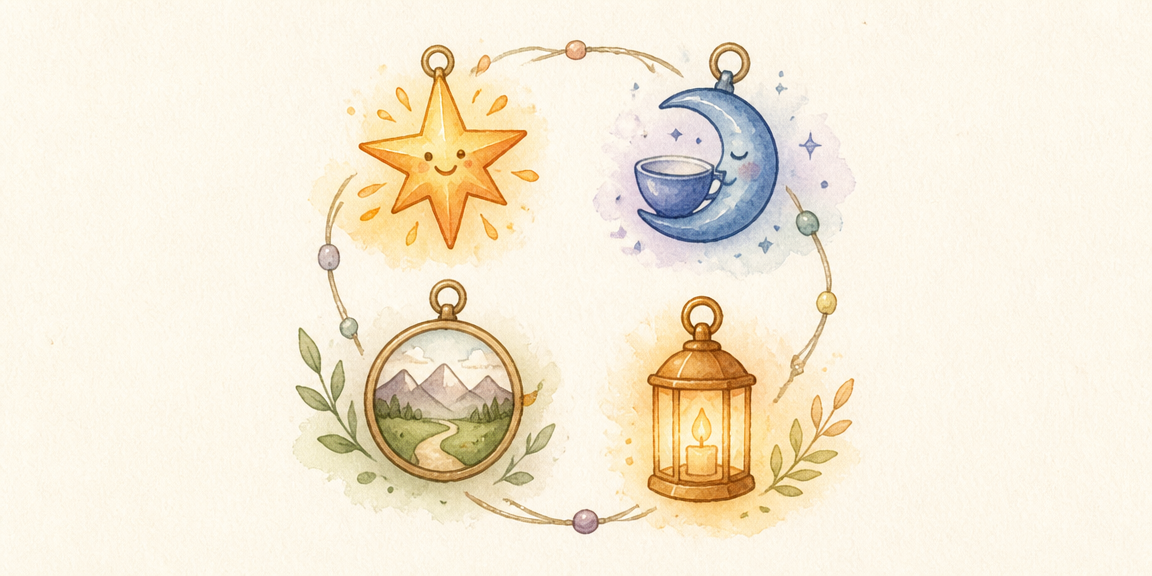
The 4 Friendship Types: Cheerleader, Listener, Adventurer, and Loyal Guardian
Friends bring different things to the table — energy, deep listening, adventure, and steady loyalty. A practical look at the four friendship types and how they fit together.
Not all friendships are the same — and not all friends bring the same thing to the friendship. There's the friend you call when you need someone to cheer for you. There's the friend you call when you need to be heard. There's the friend who drags you out of your apartment when life has gotten too small. There's the friend who has been around for fifteen years and will be around for forty more. We tend to lump all of these into the single word "best friend," but they're doing very different jobs.
There are four that show up again and again: the Cheerleader, the Deep Listener, the Adventure Buddy, and the Loyal Guardian. Each brings something different, shines in a different moment, and has its own blind spot — and a friend group runs best with a spread of them, not four of the same kind. There's a quick quiz at the end to peg which one you are, and it's worth sending to your closest people to see what they come out as.

📣 The Cheerleader — Believes in You Before You Do
The Cheerleader is the friend whose faith in someone arrives before that person has it for themselves. They hype, they celebrate, they remember the dream you mentioned six months ago and bring it up at exactly the right moment. Friends quote things a Cheerleader said to them years later, because the encouragement stuck. "You told me I could do it that night, and that's actually why I tried."
Cheerleaders shine in hard transitions — new job, breakup recovery, the first attempt at a scary thing. Their friends gather courage from the Cheerleader's voice in their own head — "they would say I can do this" — and that voice often gets them across the finish line. Cheerleaders also tend to be the spark in a group setting, the friend who turns a tired weeknight dinner into something everyone is glad they showed up to.
The shadow side: Cheerleaders sometimes default to praise when a friend actually needed honesty. If you only have the "you're amazing" track running, you might miss the moments where the same friend needed to hear something harder — "I love you, and I think you're avoiding the real conversation here." The best Cheerleaders cheer for the whole friend, including the part of them that needs to hear a difficult truth. Encouragement plus honesty is the upgrade.
🌙 The Deep Listener — Where Real Conversations Land
The Deep Listener is the friend that people end up telling their realest things to. Not the gossip layer, not the surface frustration — the underneath layer. They don't interrupt with advice nobody asked for. They let silences exist. They ask one good question instead of three nervous ones. People often describe time with this friend as "I didn't realize I needed that" or "I haven't talked about that in years."
This is a rare and quiet kind of gift, and most friendships don't have someone like this in them. Deep Listeners shine in hard nights, identity questions, and the conversations a person can only have with one specific friend — the kind of conversation that wouldn't be safe with anyone else. They're the 11pm call when something has cracked, and they're also the person who, weeks later, gently remembers what was going on for their friend and asks how it's resolving.
Deep Listeners often have fewer friendships than other types — but the ones they have tend to last decades, because the depth keeps people coming back. They also rarely get fooled. They notice when someone is pretending to be fine. They might not say anything in the moment, but they remember, and they check in two days later when the dust has settled.
The shadow side: Deep Listeners can quietly become mirrors that don't show their own face. If most of your friendships involve you holding space for them and very little of them holding space for you, that imbalance creeps up over years. You may also withhold your own struggles because you've built an identity around being the steady one — and then nobody knows when you're not okay. The growth move is to occasionally let your closest people into something you'd normally process alone, even just one true thing. Most listeners discover that the people in their life have been waiting for that opening.

🌍 The Adventure Buddy — Life Gets Bigger When They're In It
The Adventure Buddy is the friend whose presence makes life feel bigger. They drag people up the trail. They book the trip when everyone else is still saying "we should." They're the reason the night didn't quietly end at 10pm. They don't necessarily love thrill for its own sake — what they actually love is the feeling that life is being lived, and they bring their friends into that feeling by sheer momentum.
This friend's strength is memory creation. Their friends end up with disproportionately many good stories from their lives, because the Adventure Buddy keeps making things happen that wouldn't have happened otherwise. "Remember when we drove to that town at 3am for no reason?" "Remember when you forced me onto that boat?" Those stories accumulate, and they're a real form of wealth that not every friendship produces.
Adventure Buddies shine when their friends are in a rut. When a friend has been small and tired for too long, the Adventure Buddy is the one who shows up and pulls them outside, literally or figuratively. They often have a near-magical ability to make a friend say yes to something they would have said no to alone.
The shadow side: Adventure Buddies can mistake doing something with a friend for being close to a friend. The trip to Lisbon is wonderful, but it's not the same thing as the long conversation in the kitchen at 1am. Some friends need adventure with you. Some friends need stillness with you. Reading which one is needed in a given season is the next level for Adventure Buddies. They can also exhaust people — their default speed is fast, and not every friend can match that every week. Loving an Adventure Buddy sometimes means asking for a slow Sunday now and then.
🛡️ The Loyal Guardian — Doesn't Go Anywhere
The Loyal Guardian is the friend who stays. Other friendships flare and fade; theirs have a quiet, deep root system that has been in place since middle school, since the first hard year, since whenever they decided this person was their person. They're not usually the loudest in the room and they're not always the first text on a Friday night — but they are the 2am call, the no-questions-asked airport pickup, the friend who picks up after a six-month silence exactly where you left off as if no time has passed.
The Loyal Guardian's particular strength is being a historical witness to a friend's life. They remember who their friend was at 19. They watched their friend survive whatever they survived. Most people don't have many witnesses like that in their adult life, and a Loyal Guardian provides one. They tend to be hard to fool, too. They can tell when someone is pretending to be fine, and even if they don't say so in the moment, they remember and check in privately when the room has cleared.
Where Loyal Guardians shine: the long arc of a person's life. Big anniversaries, hard family seasons, milestones nobody else around remembers. The years where everyone else has scattered to their own lives, the Loyal Guardian is still there, in low key but reliable presence.
The shadow side: Loyalty without honesty can curdle into accommodation. "They're my friend" can quietly become an excuse to overlook patterns a less loyal friend would have called out years ago. Loyal Guardians can also stay too long in friendships that have stopped being mutual, because staying is the point — but they deserve people who stay for them the way they stay for others. The growth move is to pair loyalty with occasional truth: "I love you, I'm here, and I think this is the third time we've had this same conversation." That's loyalty at full strength.
💛 What Happens When the Four Types Mix
The healthiest friend groups usually have some mix of all four types. A group with only Cheerleaders feels great before big decisions but doesn't hear hard truths. A group with only Deep Listeners has rich conversations but can struggle to take action. A group of only Adventure Buddies generates a lot of stories but rarely sits still long enough to reflect. A group of only Loyal Guardians feels safe but can also feel a little small.
The four types pair especially well with their natural opposites. Cheerleaders and Deep Listeners balance each other — the listener slows the cheerleader's hype down enough to mean something, the cheerleader reminds the listener they're worth hyping. Adventure Buddies and Loyal Guardians balance each other — the Guardian gives the adventurer a steady place to land, the adventurer keeps the Guardian's life from getting too small. Having at least one friend who is your opposite type is one of the most underrated forms of friendship insurance.
Knowing your own type means knowing what you give your friends by default. Cheerleaders catch themselves cheering on autopilot and consciously add other moves. Deep Listeners check whether the friendship is mutual or one-directional. Adventure Buddies notice when they're dragging instead of inviting. Loyal Guardians notice when they need to say something harder than just being present.
✨ Wrapping Up — What's Your Type?
Friendship types aren't "good friend vs. bad friend." They're just different colors people bring to friendship. Knowing which color you bring most often means you can consciously add the colors you're missing, and you appreciate the presence of friends who bring different colors than you do.
A quick 10-question quiz can give you a starting read on your type. Even better, send it to your closest friends afterward — seeing what mix you have together is genuinely illuminating, and surprisingly fun.
👉 Take the Friendship Type Quiz — what kind of friend are you?
A few related pieces if you want to keep exploring relationships and self-knowledge:
- 💕 Attachment Styles in Relationships — what patterns show up for you?
- 🧠 Emotional Intelligence — the other axis of self-understanding
- 💝 The Five Love Languages — how affection is expressed differently in close relationships
Note: This guide is built for self-reflection and entertainment. Real friendships are more complex than any four-category model, and the same person can bring different colors in different seasons of life. Don't lock yourself or your friends into a single type. Use this instead as a tool for asking "what color are we missing right now?"
Some of the frameworks here are well-researched, some are mostly tradition. The books and studies behind each one — and how solid each is — are listed in our editorial sources.
Take the quiz
What Kind of Friend Are You? 💛
Reading about it is good — finding your own result is better.
Read the in-depth guide
Personality Guide
Related Articles
The 5 Love Languages: How to Connect Deeper with Your Partner
Discover Gary Chapman's 5 Love Languages — Words of Affirmation, Quality Time, Gifts, Acts of Service, and Physical Touch. Find your love style.
Read More
4 Attachment Styles: Which One Are You?
Explore the science of attachment theory — from Bowlby's foundational research to the four adult attachment styles and proven strategies for healing insecure attachment.
Read More
Emotional Intelligence (EQ): The 4 Domains and How to Use Them in Real Life
Emotional intelligence isn't a fixed trait — it's four trainable muscles. A practical guide to self-awareness, self-management, social awareness, and relationship management.
Read More