What an IQ Test Actually Measures (and What It Quietly Misses)
An IQ score is a rank, not a verdict on your worth. Here's what the number really tracks, what it skips, and why a quick online score is a game.
A kid who couldn't read a clock and aced the math
Years ago a friend who tutors told me about a boy he worked with. Eleven years old, sharp as anything with numbers, could factor in his head faster than my friend could write it down. On the school's group IQ-style screening he landed in the top few percent for reasoning. The same kid couldn't tell time on an analog clock, forgot his lunch three days a week, and froze the moment a question came wrapped in a paragraph of words instead of digits.
So what was his "IQ," really? The test gave one number. The number was true and useful and also missed almost everything that made the morning interesting for the adults around him.
That gap is the whole subject here. An IQ test measures something real. It just measures a narrow slice, and the slice gets sold to us as if it were the whole person. If you've ever taken a quick IQ challenge and either glowed or sulked at the result, this is for you — because the result deserves a lot less of your emotion than it usually gets.
The number is built out of parts
When people say "IQ" they picture one tidy figure. Behind that figure is a stack of separate abilities the test pokes at, and they don't all move together.
Fluid intelligence is the on-the-spot reasoning kind. New problem, no script, figure out the pattern. Which shape comes next in the sequence? What's the rule connecting these three things you've never seen before? It's the part that feels most like raw horsepower, and it tends to peak in your twenties and slowly drift down after that. Annoying, but true.
Crystallized intelligence is the opposite shape. It's everything you've already learned and packed away — vocabulary, facts, the accumulated know-how of having lived a while. This one keeps climbing for decades. A sharp sixty-year-old usually crushes a sharp twenty-year-old on the crystallized side even as the younger one wins on fluid speed. The two trade places over a life, which is why "who's smarter, the kid or the professor" is a badly posed question.
Then there's working memory — how much you can juggle in your head at once. Hold these numbers, now reverse them. Keep the start of this sentence alive while you parse the end. It's the mental desk space, and it's smaller than anyone wants it to be.
And processing speed, which is just how fast the wiring runs. How quickly you scan a page, match a symbol, notice a difference. Speed is part of most timed tests, which means a slow, careful, deep thinker can score lower than a fast, shallow one. Worth sitting with that for a second.
A full clinical IQ test measures all four and more, then blends them. The boy with the clock? Sky-high fluid reasoning, average-or-below working memory and a processing style that fell apart under word problems. One number flattened all of that into a single rank. Useful for placing him in a class. Useless for understanding him.
The bell curve, and why your score is a seat number
Here's the part that quietly defangs the whole thing once you get it.
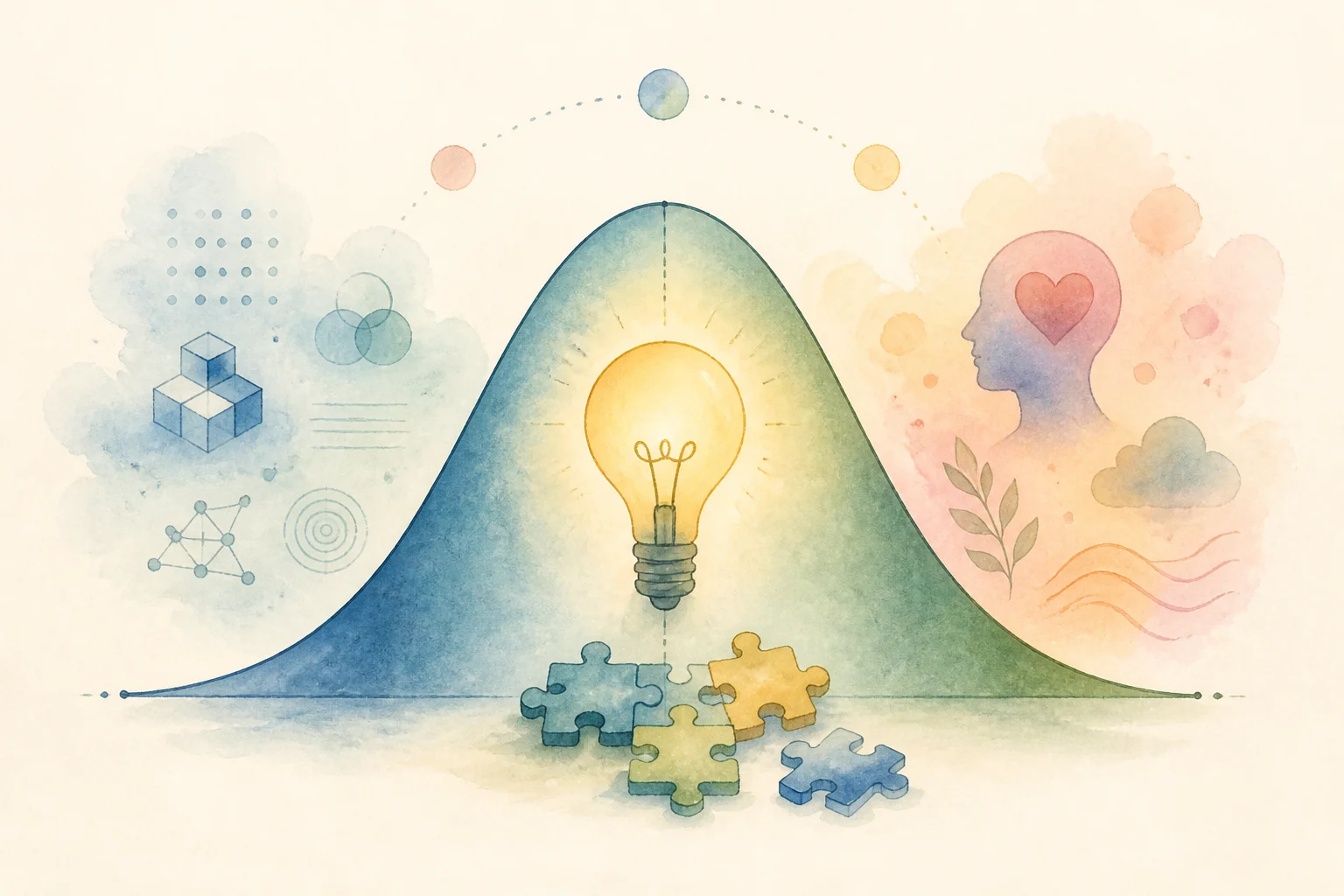
IQ scores are built to fall on a bell curve. The average is set at 100 — not because 100 is some natural constant of the brain, but because the test makers *decided* the middle of the pack would be called 100. Everything else is measured against that middle. About two-thirds of people land between 85 and 115. Score 130 and you're roughly in the top 2 percent; score 70 and you're in the bottom 2. The whole system is relative. Your score doesn't say how much intelligence you "have" in some absolute sense. It says where you sat relative to everyone else who took the same test.
That reframing matters more than it sounds. A score of 120 doesn't mean you possess 120 units of brain. It means roughly 90 percent of people scored lower than you on that particular set of puzzles on that particular day. It's a seat number in a ranked room, not a measurement of a substance. Change the room, change the puzzles, change your sleep the night before, and the seat moves.
Which is exactly why turning a rank into a verdict on your worth is a category error. A percentile can tell you that you reason through abstract patterns faster than most. It cannot tell you whether you're kind, whether you'll finish hard things, whether people trust you, or whether your life will be any good. Those run on completely different rails, and the test doesn't go near them. More on that in our IQ guides, which keep circling back to this exact point because it's the one people most want to forget.
What the test walks right past
Line up the things we actually admire in people and notice how few of them an IQ test touches.
Creativity. The test rewards converging on the one correct answer. Most real creative work is the reverse — diverging, generating ten weird options, tolerating the ugly draft long enough to find the good idea hiding in it. There are people with monster IQ scores who can't produce a single original thought, and people in the middle of the curve who reshape whole fields. The test isn't built to see the second group.
Reading a room. Knowing your friend is upset before she says a word. Sensing the meeting has turned and the boss needs you to stop talking. That fast, fluent read of other humans is a genuine skill, often a rare one, and the test is blind to it. Plenty of high scorers are spectacularly bad at it.
Wisdom. Not knowing things — *knowing what to do* with what you know. When to push and when to let go. Which battle is worth it. How to be wrong gracefully. Wisdom is mostly built from experience and reflection, and a clever twenty-year-old can be deeply foolish while a moderate scorer of seventy is the one everyone calls for advice.
And then the quiet giants: motivation and grit. Show me a high score with no drive and I'll show you wasted potential, a phrase teachers wear out for a reason. The capacity to want something and keep going when it's boring and hard — that predicts how a life actually turns out at least as much as raw reasoning, arguably more. The test measures the engine. It says nothing about whether you'll ever turn the key.
Honestly, if you handed me two people and let me bet on who'd build a good life, I'd want to know about their grit and their decency long before I'd ask for a score.
The Flynn effect, or why your grandparents would "fail" today
Here's a fact that should make anyone treat the number with a raised eyebrow. Across the twentieth century, raw IQ scores climbed steadily, generation after generation, in country after country. Roughly three points a decade in many places. A researcher named James Flynn documented it so thoroughly the pattern carries his name.
Think about what that means. Score the average person from 1930 on today's norms and they'd land well below average — they'd look, on paper, almost impaired. Were our great-grandparents dim? Of course not. They built things, ran farms, survived wars, raised us. What changed wasn't the brain. It was the world: more schooling, more abstract problems baked into daily life, better nutrition, a culture that constantly asks you to think in categories and hypotheticals the way the test does. We got better at the *kind of thinking the test rewards*, which is not the same as getting wiser.
The Flynn effect is the loudest possible reminder that IQ is measuring something culturally shaped and historically moving, not a fixed essence stamped into you at birth. A number that drifts that much across mere decades is not the bedrock people treat it as.
So why does a 60-second online quiz feel so real?
Because it's designed to. A free online "IQ test" gives you a slick number, a confident percentile, maybe a certificate, and your brain happily files it next to the real thing. It isn't the real thing, and the gap is enormous.
A proper IQ assessment takes one to two hours, is administered one-on-one by a trained psychologist, uses tests kept deliberately out of public circulation so you can't practice them, and is normed against a large, carefully matched sample. The examiner watches *how* you solve, not just whether you do. It costs real money and produces a report, not a shareable score.
A web quiz is none of that. It's ten or fifteen pattern questions with no supervision, no real norming, and a number often nudged generously upward so you feel good and share it. That's not an insult to the quiz — it's the honest description of what it is. A quick IQ challenge is a fun puzzle that shows you a few patterns in how you think, the same way a crossword does. Treat the resulting number as a high score in a game, not a fact about your mind. If you want lighter reading in the same honest spirit, the rest of the guide library is right there.
The truth under all of this is almost freeing. The number was never the point. A score is a narrow snapshot of how you handled a specific set of puzzles relative to other people, on a scale someone invented, in a world that keeps shifting under it. It says nothing about your creativity, your kindness, your judgment, or your grit — the stuff that actually decides how things go. Take the result, enjoy it, and then go be a person, which the test could never measure anyway.
---
*One honest line to close on: any IQ score you get from Selvora is for fun and curiosity, not a certified IQ assessment and definitely not a measure of your worth. If you want a real evaluation, a licensed psychologist is the only place to get one. Everything here is a game — play it lightly.*
Try the related quiz
Quick IQ-Style Logic Quiz 🧩
More from this hub
The Four Puzzle Types Every IQ Test Uses, and How to Crack Them
Matrices, number sequences, analogies, spatial rotation. A real method for each, plus the awkward truth about why practice raises your score.
Do Brain-Training Apps Actually Work? An Honest Read
You get scary good at the game. But does that carry over to real life? What the research actually found about brain-training apps.
That "Free IQ Test" Score Isn't a Real IQ. Here's Why.
Online IQ tests aren't normed, proctored, or honest about who took them. Here's how the funnels work and what a real assessment looks like.