The Four Puzzle Types Every IQ Test Uses, and How to Crack Them
Matrices, number sequences, analogies, spatial rotation. A real method for each, plus the awkward truth about why practice raises your score.
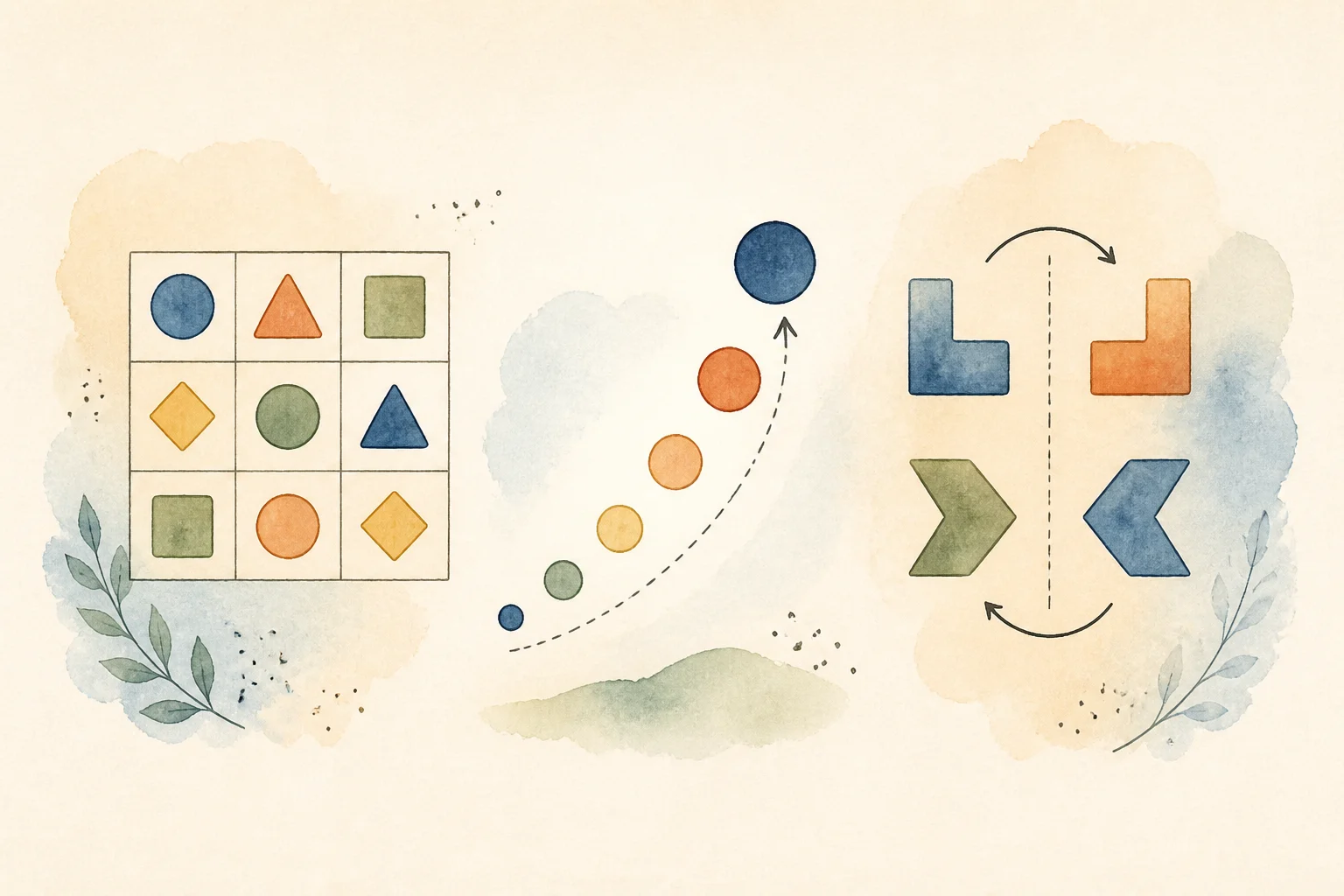
The grid that made me feel stupid
The first time I saw a Raven's matrix I genuinely thought I was missing something obvious. Eight little boxes in a three-by-three grid, each with some arrangement of shapes, and the ninth box empty with a question mark. Below it, eight candidate answers, all of which looked plausible and three of which were clearly traps designed by someone who enjoyed my suffering.
I stared. I picked one based on vibes. I was wrong.
Here's the thing nobody tells you walking in: that grid wasn't testing whether I was smart. It was testing whether I knew how to *read* the grid. Once a friend showed me the actual method — and there is a method — my score on those things jumped in about twenty minutes. Not because my brain changed. Because I finally understood the format.
That gap, between solving the puzzle and reading the format, is what this whole article is about. There are really only four families of these puzzles you'll meet on almost any test, including the quick IQ challenge we have here. Learn the four, and the scary blank box stops being scary.
Matrices: read the rows, then read the columns
The matrix puzzle — the Raven's-style grid — is the king of visual reasoning tests, and it intimidates people far more than it should. The mistake almost everyone makes is to look at the whole grid at once, take in the swirling mess of shapes, and try to feel the answer. Don't do that. Your eyes will lie to you.
Instead, go one direction at a time. Pick the top row and ask a single question: what changes as I move left to right? Maybe a shape rotates ninety degrees each step. Maybe one dot gets added per box. Maybe the color flips, or a line gets longer, or an element disappears. Whatever it is, name it out loud in plain words. "The arrow turns clockwise." Now check the middle row. Does the same rule hold? It almost always does. Tests are built on consistency.
Then do the exact same thing down the columns. Top to bottom, what's the rule? Often there's a separate rule running vertically — the row rule controls one feature, the column rule controls another. A classic example: across each row the number of sides on the shape increases, while down each column the shading gets darker. The missing box, bottom-right, has to obey *both*. So it's the darkest shading and the most sides. Suddenly there's exactly one right answer, and the seven traps fall away.
The two-pass habit — row rule first, column rule second, then combine — turns the matrix from a guessing game into something almost mechanical. Honestly, most of the difficulty was never the logic. It was that nobody told you to split the grid into directions.
One more tip: if a row seems to have no pattern, look for a rule that involves all three cells together rather than step-by-step changes. Sometimes the third shape is the first shape combined with the second, or the first minus the second. That overlay trick catches people constantly.
Number sequences: differences first, ratios second
4, 9, 16, 25, ___. You probably got that without trying. But what about 2, 6, 12, 20, 30, ___? Slower, right? There's a simple drill that handles nearly all of these, and you do it in a fixed order.
First, write the differences between consecutive numbers underneath the sequence. For 2, 6, 12, 20, 30 the gaps are 4, 6, 8, 10. See it? The differences themselves go up by two, so the next gap is 12, and the answer is 42. Most sequences crack at this stage. The differences are either constant (it's just adding a fixed amount), or they form their own neat little pattern.
If the differences are a chaotic mess, switch to your second tool: ratios. Divide each number by the one before it. For 3, 6, 12, 24 the ratio is 2 every time — it's doubling. For 96, 48, 24, 12 the ratio is one half. Geometric sequences hide from the differences method but surrender instantly to division.
Still nothing? Now check the obvious suspects. Squares: 1, 4, 9, 16, 25. Cubes: 1, 8, 27, 64. Primes: 2, 3, 5, 7, 11. And the one everybody loves, Fibonacci, where each number is the sum of the two before it: 1, 1, 2, 3, 5, 8, 13. Tests reuse these constantly because they look clever and they're easy to print.
The sneakiest sequences are two interleaved patterns wearing a trench coat. Take 1, 10, 2, 20, 3, 30. Looks random until you realize the odd positions count 1, 2, 3 and the even positions go 10, 20, 30. Two simple sequences zipped together. Whenever the differences and ratios both look insane, try reading every other number — there's a decent chance two calm patterns have been braided into one scary one.
Differences, then ratios, then the usual suspects, then check for interleaving. That four-step sweep solves the large majority of what any test will throw at you.
Verbal analogies: build the sentence, then test it
These read like a riddle. "Bird is to nest as bee is to ___?" The trap is to grab the answer that simply feels associated with bees. Honey is about bees! So people pick honey, and they're wrong, because that's not the relationship the puzzle set up.
The fix is almost embarrassingly simple. Turn the first pair into a precise sentence that captures *exactly* how they relate. "A bird lives in a nest." Good — now that's your template, and you apply it word for word to the second pair. "A bee lives in a ___." A hive. Honey doesn't fit the sentence at all; a bee does not live in honey. The sentence does the filtering for you.
The whole game is naming the relationship sharply. Vague gets you killed here. "They're related" is useless. "A is a smaller version of B" or "A is the tool you use to do B" or "A is the opposite of B" — that level of precision is what you need. Is it part-to-whole? Cause and effect? A thing and its function? Degree, like warm to hot? Pin it down before you even glance at the choices.
Then there's a quiet warning sign. If two of the answer options would both work, your sentence wasn't specific enough. Go back and tighten it until only one survives. Test writers plant near-misses on purpose, and a loose relationship sentence walks you straight into them. A sharp one cuts through every time.
Spatial rotation: track one feature, ignore the rest
Now the puzzles people either love or quietly dread. A shape is shown, then four or five rotated versions, and you have to find the one that's the same object simply turned in space — versus the decoy that's been mirror-flipped, which is a different object pretending to be innocent.
The error here is trying to rotate the entire shape in your head at once. For anything complicated, that's a recipe for a headache and a wrong answer. Don't hold the whole thing in your mind. Instead, lock onto a single distinctive feature and follow only that. A little tail sticking off one corner. An arrow. One odd-colored square. Pick the most unique landmark on the figure and ask where it would end up after the rotation. Then scan the options for the one where your landmark sits correctly. The decoys usually get the overall shape right but put your landmark in the wrong spot, which is exactly how you catch them.
The mirror-image trap deserves its own paragraph because it fools so many people. A rotation and a reflection can look almost identical at a glance, but they are not the same. Quick test: pick two features and check the order they go in, like clockwise. If the original reads A-then-B-then-C going clockwise, a true rotation keeps that clockwise order. A mirror image reverses it to counterclockwise. When two options seem equally right, this clockwise-order check is the tiebreaker that saves you.
And if you're someone who finds spatial stuff genuinely hard — a lot of perfectly sharp people do — take comfort that this is the most trainable family of the four. Mess with these for a week and watch the gains pile up, which leads neatly into the slightly awkward truth underneath all of this.
Why practice raises your score (and why that's a little awkward)
Let me be straight with you, because it's the most honest and most useful thing in this article. When you practice these puzzles and your scores climb, your underlying intelligence is not climbing with them. What's improving is your familiarity with the format.
Think about what's actually happening. The first time you meet a matrix, you burn precious effort just figuring out *what kind of question this even is*. By the fiftieth, you instantly recognize "ah, two-rule grid, row controls shape, column controls shading," and you spend your energy on the answer instead of on decoding the question. You've learned the conventions — the standard tricks, the typical traps, the handful of patterns that get recycled forever. That's real and it's worth something, but it is a learned skill, not a raised ceiling.
This is the open secret behind every "I raised my IQ by 15 points!" story online. They didn't get smarter. They got fluent in test-taking. It's the same reason your second driving test goes better than your first even if you're no better a driver — you simply know what's coming. Useful to know if you ever face a real high-stakes test: a few practice rounds will lift your score purely through familiarity, no brain upgrade required. And useful for keeping your ego in check when a casual online quiz hands you a flattering number. The number partly measures how many of these you've already done.
None of which means the puzzles are pointless. They're a genuinely good time. There's a clean little hit of satisfaction when a sequence finally clicks, or when the mess of a matrix snaps into a rule you can say in one sentence. Treat them like crosswords or sudoku — a pleasant mental warm-up, a thing to do on the train, a small daily win. Race a friend. Time yourself and try to beat it. Keep a couple of hard ones in your back pocket to spring on people at dinner. The enjoyment is the actual point; the score is just how the game keeps count. If you want to put the four methods to work right now, the quick IQ challenge runs through all of them, and there's more in our IQ and reasoning guides if you catch the bug.
---
*Quick reminder: puzzle practice is a fun warm-up for your brain, not a measurement of how intelligent you are. Enjoy the click of a solved pattern, share your score for laughs, and don't read a single online quiz as a verdict on your mind.*
Try the related quiz
Quick IQ-Style Logic Quiz 🧩
More from this hub
What an IQ Test Actually Measures (and What It Quietly Misses)
An IQ score is a rank, not a verdict on your worth. Here's what the number really tracks, what it skips, and why a quick online score is a game.
Do Brain-Training Apps Actually Work? An Honest Read
You get scary good at the game. But does that carry over to real life? What the research actually found about brain-training apps.
That "Free IQ Test" Score Isn't a Real IQ. Here's Why.
Online IQ tests aren't normed, proctored, or honest about who took them. Here's how the funnels work and what a real assessment looks like.