Do Brain-Training Apps Actually Work? An Honest Read
You get scary good at the game. But does that carry over to real life? What the research actually found about brain-training apps.
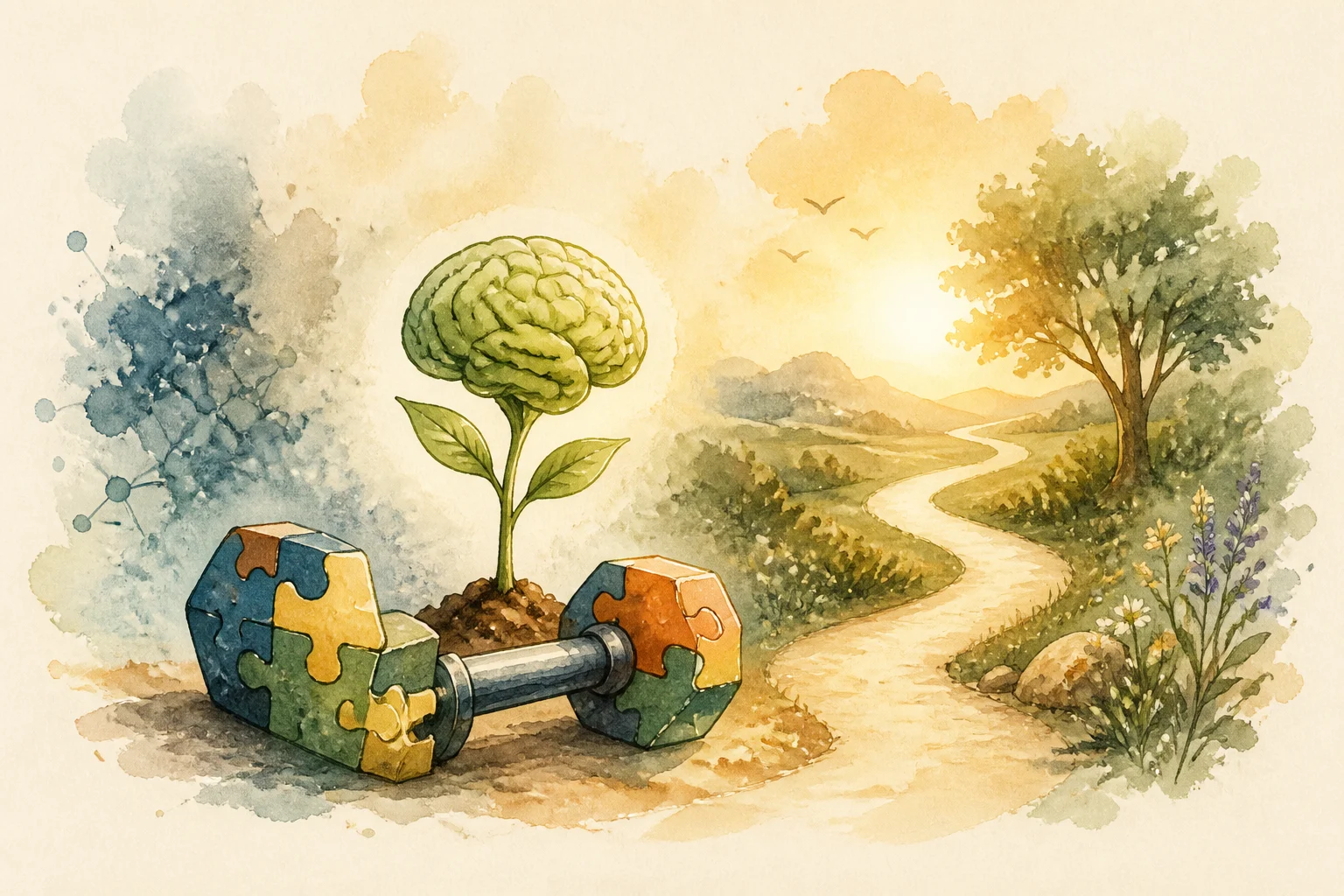
The day I beat my own high score and felt nothing
A few years back I had one of those brain-training apps on my phone. The kind with the friendly mascot and the little daily streak counter. I did the exercises most mornings on the train. Speed-matching shapes, remembering grids of dots, tapping numbers in order before they vanished.
And I got good. Genuinely good. My "working memory" score, according to the app, was climbing into some elite percentile. There was a chart. The chart went up and to the right, which is the most satisfying direction a chart can go.
Then one evening I walked into the kitchen, stood there, and could not for the life of me remember why I'd walked into the kitchen.
That was the moment it clicked. I was getting better at the app. Just the app. The grids and the dots and the tapping. Not at the messy thing we actually mean when we say "memory" or "focus" or "being sharp." The skill stayed inside the phone.
If you've ever wondered the same thing — does any of this transfer to real life? — that's the whole question, and it has a name.
The transfer problem, which ruins everything
Here's the inconvenient bit at the center of brain training. Psychologists call it the transfer problem, and once you see it you can't unsee it.
Practice almost anything and you improve at it. That's not in dispute. Do a thousand reps of a number-sequencing task and you will get faster at number-sequencing tasks. This is called near transfer — the gains spill over to stuff that looks basically identical to what you trained.
The promise the whole industry was built on is far transfer: train on the puzzles, get smarter in general. Better at your job. Sharper in conversations. More on top of your keys and your appointments and the name of the person you just met.
Far transfer is the thing that mostly doesn't happen.
The pattern across study after study looks like this:
- You get a lot better at the trained task.
- You get a bit better at tasks that strongly resemble the trained task.
- You get little to nothing on tasks that look different.
- General cognition — the broad thing people are actually paying for — barely moves.
Think about how strange that is for a second. Years of practice, real measurable skill, and it pools right at the edge of the activity like water that won't soak in.
What the research actually found
Let me be specific, because "studies show" is a phrase that should make you suspicious.
For a while the optimism rested on a 2008 study suggesting that training a task called the n-back could raise fluid intelligence — the on-the-fly reasoning kind, the part that feels most like "raw smarts." That paper got enormous attention. It launched a thousand apps.
The trouble started when other labs tried to reproduce it. Larger, tighter studies kept finding the effect shrinking or vanishing once you controlled for the obvious confounds. A big chunk of the apparent "improvement" turned out to be people simply getting better at taking tests, plus a placebo effect — if you're told an activity will make you smarter and you expect it to, you try harder on the after-test. That's motivation, not new cognition.
Then in 2014 a large group of scientists put out a public statement. The short version: there's no compelling evidence that these games deliver the broad benefits the marketing implies. A separate consensus statement, signed by a different set of researchers, was more upbeat — which tells you how live the argument still was. Scientists do not all agree here, and pretending otherwise would be dishonest.
The most quoted moment came in 2016. The U.S. Federal Trade Commission hit Lumosity — at the time the loudest name in the space — with a $2 million settlement for deceptive advertising. The complaint, more or less: you told people this stuff fends off age-related memory decline and even cognitive impairment, and that it sharpened performance at school and work, and you didn't have the science to back any of it. When a federal agency comes after your marketing because your science doesn't hold up, that's a fairly loud signal.
The honest summary, the one I'd actually stand behind: brain-training apps reliably make you better at brain-training apps. Evidence that they make you broadly smarter or meaningfully protect against age-related decline is weak, contested, and a lot thinner than the cheerful onboarding screen suggests. The same caution applies to any single online quiz — including the IQ and logic tests over in our IQ hub, which are fun and can show you patterns in how you think, but won't move your underlying cognition either.
"But I feel sharper"
Maybe you do. A few things could be going on. You might genuinely be better at that specific task and reading it as general improvement. You might be more alert simply because you started a daily routine, woke up earlier, sat with a clear goal. You might be experiencing the warm satisfaction of a number going up, which is a real and pleasant feeling and tells you almost nothing about your hippocampus.
None of that is an attack on you. It's just worth separating *enjoyed it* from *it rewired my brain.* They're different claims.
So what does actually help?
Here's the part that's almost annoying, because it's so unglamorous. The things with the strongest evidence for supporting cognition are mostly boring, free, and the exact stuff your grandmother would tell you to do.
Sleep. Not "sleep more" as a vague vibe — sleep is when memories get consolidated, when the day's experiences move from fragile short-term storage into something durable. Skip it and your attention, mood, and recall all degrade fast, in ways that are easy to measure. There is no app that out-performs a decent night's sleep. If you only change one thing on this list, change this one.
Aerobic exercise. This one has surprisingly solid backing. Getting your heart rate up — brisk walking counts, you don't need to become a triathlete — is associated with better executive function and, in older adults, with measurably healthier brain structure. The mechanism is partly blood flow, partly chemicals your body releases when you move that support the growth and survival of neurons. Your brain is an organ in a body. Treating the body well is not a metaphor.
Learning something genuinely hard and new. Not a puzzle you've already mostly mastered. Something that makes you feel a little stupid at first. A language. An instrument. Sketching. Actual chess against actual people. The frustration is the point — that struggle is what builds new connections, in a way that grinding a task you're already good at never will. A game gets easier as you improve, which is exactly when it stops doing much for you.
Social connection. Easy to skip past, but the research is real. Conversation is a serious cognitive workout. You're tracking what someone means versus what they said, reading a face, holding the thread, planning your reply, managing the emotional temperature — all in real time. Loneliness, over years, is linked with faster cognitive decline. A long talk with a friend may be doing more for your brain than any matching-the-shapes drill ever could.
Notice the through-line. The brain-training app is a tidy, optimized, narrow loop. The things that actually work are broad, demanding, woven into a life. Hard new effort, a body that moves, a brain that rests, people you talk to. None of it fits neatly in a daily-streak widget, which is probably why nobody's built a billion-dollar company selling it to you.
A realistic takeaway
If you like brain-training apps, keep playing them. Seriously. They're a fine little habit. Better than doomscrolling, often genuinely fun, and the routine of doing one small focused thing each morning may help in its own small way.
Just hold the right expectation. You are buying entertainment and a mild sense of accomplishment, not a smarter brain. Spend the money if it's pocket change to you. Don't spend it believing you're fending off dementia, because the evidence for that simply isn't there yet.
And if your real goal is to think more clearly? Go to bed earlier. Take a fast walk that leaves you slightly out of breath. Pick up something hard enough to embarrass you a little. Call someone and actually talk. Those four, stacked together over months, will do more for your head than any streak counter — and they're free.
Want to keep poking at how your mind works without the magic-pill framing? The rest of our IQ and reasoning guides lean the same honest direction, and there's lighter reading over in the wider guide library if you're in the mood to wander.
---
*One last thing: Selvora's quizzes and tests are for self-reflection and entertainment. Nothing here is a clinical assessment, a medical diagnosis, or a substitute for advice from a qualified professional. If you're genuinely worried about your memory or focus, please talk to a doctor — not an app, and not us.*
More from this hub
What an IQ Test Actually Measures (and What It Quietly Misses)
An IQ score is a rank, not a verdict on your worth. Here's what the number really tracks, what it skips, and why a quick online score is a game.
The Four Puzzle Types Every IQ Test Uses, and How to Crack Them
Matrices, number sequences, analogies, spatial rotation. A real method for each, plus the awkward truth about why practice raises your score.
That "Free IQ Test" Score Isn't a Real IQ. Here's Why.
Online IQ tests aren't normed, proctored, or honest about who took them. Here's how the funnels work and what a real assessment looks like.