Your Birth Chart, Explained Without the Jargon
A plain-language tour of what a birth chart actually is, why you're more than your sun sign, and how to read it as a reflective story instead of a forecast.
The sky had a particular shape the moment you were born
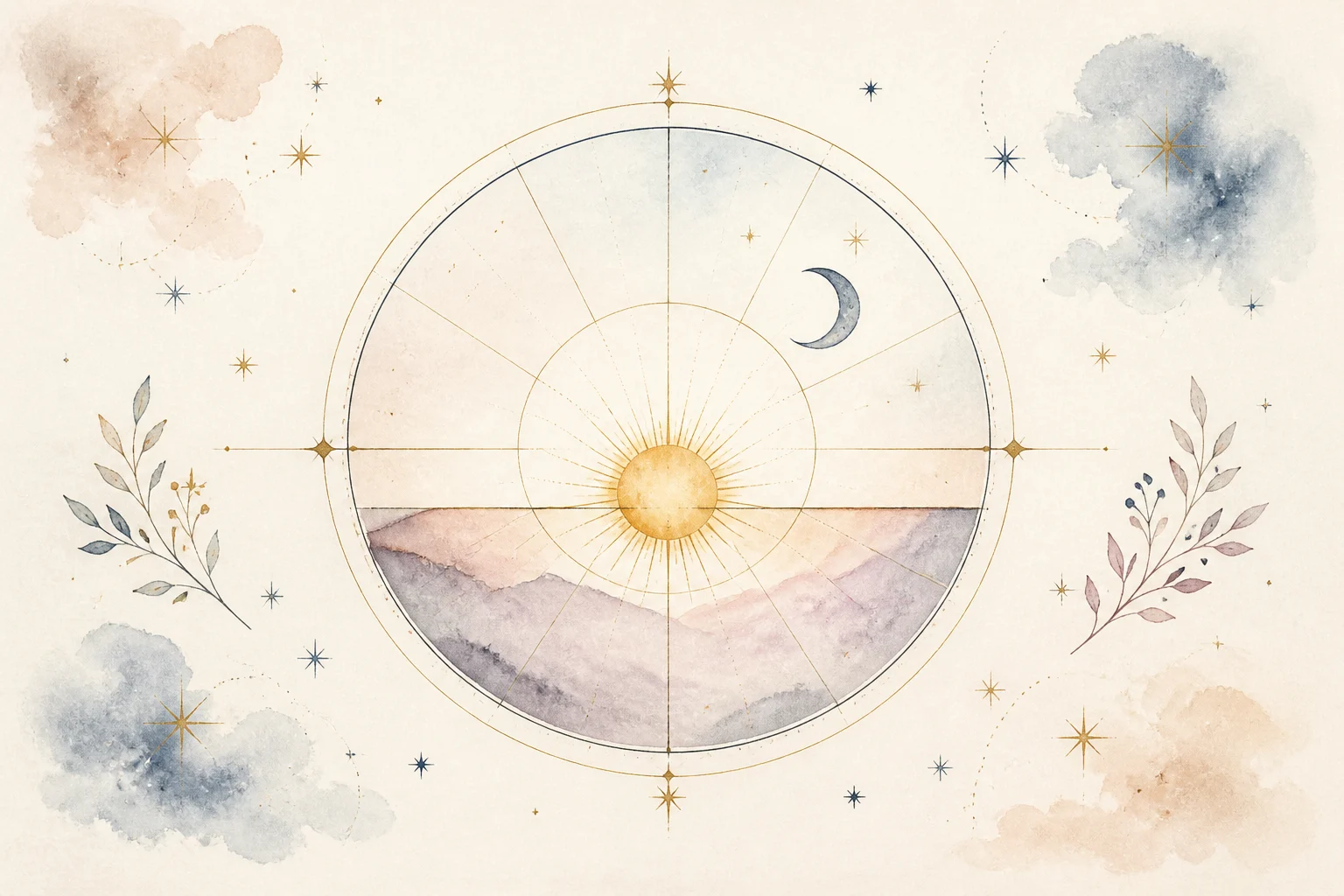
A birth chart is a map of where everything was in the sky at the exact minute and place you arrived. The sun sat at one specific spot. The moon was somewhere else. Mercury, Venus, Mars and the rest were scattered across the zodiac like seats in a theater, and an astrologer freezes that arrangement and draws it as a wheel. That wheel is your chart. It looks intimidating because it's covered in symbols nobody teaches you in school, but the underlying idea is almost embarrassingly simple: *here is a snapshot of the heavens at your first breath.*
Two people born the same afternoon in the same hospital will have charts that are nearly identical but not quite. Move the time by twenty minutes and the whole wheel can rotate. That sensitivity is exactly why people find charts compelling, and also why you should hold the whole thing lightly. We'll get to that. First, let's make the symbols stop being scary.
Sun, moon, rising: the trio people actually use
If you've only ever known your "sign," you know your sun sign — the constellation the sun was passing through on your birthday. It's the headline. And it does track something real about how astrology talks about you: your core drive, the thing you're reaching toward, the role you'd cast yourself in. But the sun is one body among many, and reading a person by their sun alone is like reviewing a film by its title.
Here's the trio worth knowing:
- Sun — your central motivation, the self you're growing into. The part that wants to shine.
- Moon — your inner emotional weather: how you self-soothe, what you need to feel safe, the you that shows up at 2am when nobody's watching.
- Rising (or ascendant) — the sign that was climbing over the eastern horizon at your birth. It's your first-impression self, the doorway people walk through before they meet the rest of you.
This is why someone can say *"I never felt like a typical Aries"* and be telling the truth as astrology understands it. Maybe they're an Aries sun with a Pisces moon and a Cancer rising: fiery ambition wrapped in soft, watery, protective layers. The clichéd Aries description was only ever describing one third of the picture. So when people tell you you're "more than your sun sign," this is the concrete thing they mean. There are a dozen placements in your chart, and the sun is just the loudest one in the room.
Planets and houses, loosely
The chart has two kinds of moving parts, and you can grasp both without memorizing anything.
The planets (astrology counts the sun and moon as "planets" too, which annoys astronomers, and we'll let it slide) each represent a flavor of human experience:
- Mercury — how you think and talk.
- Venus — how you love and what you find beautiful.
- Mars — how you assert, want, and fight.
- Jupiter — where you expand, get lucky, overdo it.
- Saturn — where you meet limits, discipline, and the slow grind of growing up.
The houses are twelve slices of the wheel, and they answer a different question. If the planets are *what,* the houses are *where in your life.* The first house is roughly about self and appearance, the seventh about partnership, the tenth about career and public reputation, and so on around the circle. So a planet "in" a house is a flavor landing in a life area. Mars in the tenth house reads as drive aimed at your career. Venus in the fourth reads as love expressed through home and family. None of it is a formula with a single answer. It's closer to a vocabulary that lets you tell a layered story about yourself, and different astrologers will tell slightly different stories from the same wheel.
There's a third layer, and you can file it under "good to know it exists." Astrologers also look at aspects, the angles planets make to each other across the wheel. Two planets sitting close together are said to blend. Planets at a tense angle are said to grind against each other. Planets in easy alignment are said to flow. You don't need to learn any of this to enjoy a chart. But it's why a reading can feel surprisingly specific: the astrologer isn't reading one placement at a time, they're reading the whole conversation between the parts. That's also where two readers diverge most. The same square between Mars and Venus is "you fight with the people you love" to one astrologer and "you have unusual creative drive" to another. Neither is wrong, because neither is a measurement.
That last point matters. A chart isn't a fixed readout you decode the way you'd read a thermometer. It's a prompt, and the meaning gets made in the reading.
Read it as a story, not a forecast
The most rewarding way to look at your chart is to treat it as a piece of reflective writing about you that you get to argue with. You read "Saturn in the seventh house, you take relationships seriously and learn through them slowly," and instead of asking *is this true,* you ask *does this land?* Sometimes it lands hard and gives you a word for something you'd felt but never named. Sometimes it misses completely, and noticing the miss tells you something too.
Used this way, a chart is a mirror with a slightly poetic tilt. It can surface a pattern you'd been avoiding, give you language for a tension you carry, or just make you sit for ten minutes with the question *what do I actually want.* That's genuinely valuable, and it has nothing to do with whether the position of Saturn at your birth caused anything.
There's a quiet psychology behind why this works. A good chart description is broad enough that most people can find themselves in it, which sounds like a flaw until you realize it's also true of any thoughtful question about your character. The chart isn't telling you who you are. It's handing you a frame and inviting you to fill it. When the description fits, that's usually because you brought a real memory to it. When it doesn't, you learn where the frame and the real you part ways. Either way you've spent ten minutes paying attention to yourself, which most of us do far too rarely, and which almost nothing on a phone is designed to encourage.
What a chart does *not* do well is tell you what Tuesday holds, whether to take the job, or which person to date. The moment you ask it to forecast, you've handed a reflective tool a job it was never built for. A chart describing your tendencies can be moving and useful. A chart "predicting" your week tends to produce either false comfort or unearned dread. Keep it in the first lane. If you want a fuller version of that boundary, our guide on reading astrology responsibly walks through where the healthy line sits and how to notice when you've crossed it.
The honest part
Here's the thing you deserve to hear plainly: there is no good scientific evidence that the positions of planets at your birth shape your personality or predict your future. Studies designed to test astrological claims, matching charts to personality, to compatibility, to life outcomes, have come up empty, repeatedly and across decades. The sun "in Leo" is a labeling convention, not a force acting on a newborn. This isn't a fringe doubt. It's the settled view outside of astrology itself.
So why bother? Because a birth chart can be a beautiful, structured way to think about a life without being literally true. Poetry isn't a forecasting system either, and nobody throws out a poem for failing to predict the weather. A chart gives you a rich vocabulary, a set of evocative prompts, and a centuries-old tradition of people watching the sky and using it as an excuse to look inward. Enjoyed as a symbolic language, it's a genuine pleasure and a real reflective tool. Mistaken for evidence, it quietly starts making your decisions for you, and that's where it does damage.
Hold both ideas at once and you get the best of it. The chart is a gorgeous, intricate story about a person who's worth a story. You're just the one who decides which parts are true.
Where to start with your own
If you want to actually look at yours, you need three things: your birth date, your birth time (the more exact the better, since the rising sign and house cusps depend on it), and your birth city. Free chart generators will draw the wheel in seconds. Don't panic at the glyphs. Start with the trio: find your sun, moon, and rising, and read each placement as a sentence about a part of you. Then notice which ones make you nod and which ones make you frown. Both reactions are information.
You don't need to believe the sky is sending a message to get something out of this. You just need to be willing to sit with a few well-chosen sentences about yourself and ask, honestly, *how much of this is me?* That question is worth answering whether or not the stars had anything to do with the asking. If you're curious to see your full chart laid out, our zodiac reading is a gentle place to begin.
More from this hub
Tarot and Astrology as Entertainment — A Reader's Guide
Tarot decks and astrology apps are everywhere — and they work best when you read them as imaginative content, not as forecasts. A grounded look at how to enjoy the symbolism, what tips it from play into harm, and how Selvora treats the genre.
Tarot for Journaling: Five Prompts That Actually Move Things
A small, pretentious-free guide to using tarot cards as journaling prompts — written by people who don't promise the future, but do promise that better questions help.
Zodiac Compatibility — Entertainment vs Real Relationships
Zodiac compatibility content is fun, visually rich, everywhere. This separates what the tradition is doing from what real relationships need — and how to enjoy one without quietly replacing the other.