Tarot for Journaling: Five Prompts That Actually Move Things
A small, pretentious-free guide to using tarot cards as journaling prompts — written by people who don't promise the future, but do promise that better questions help.
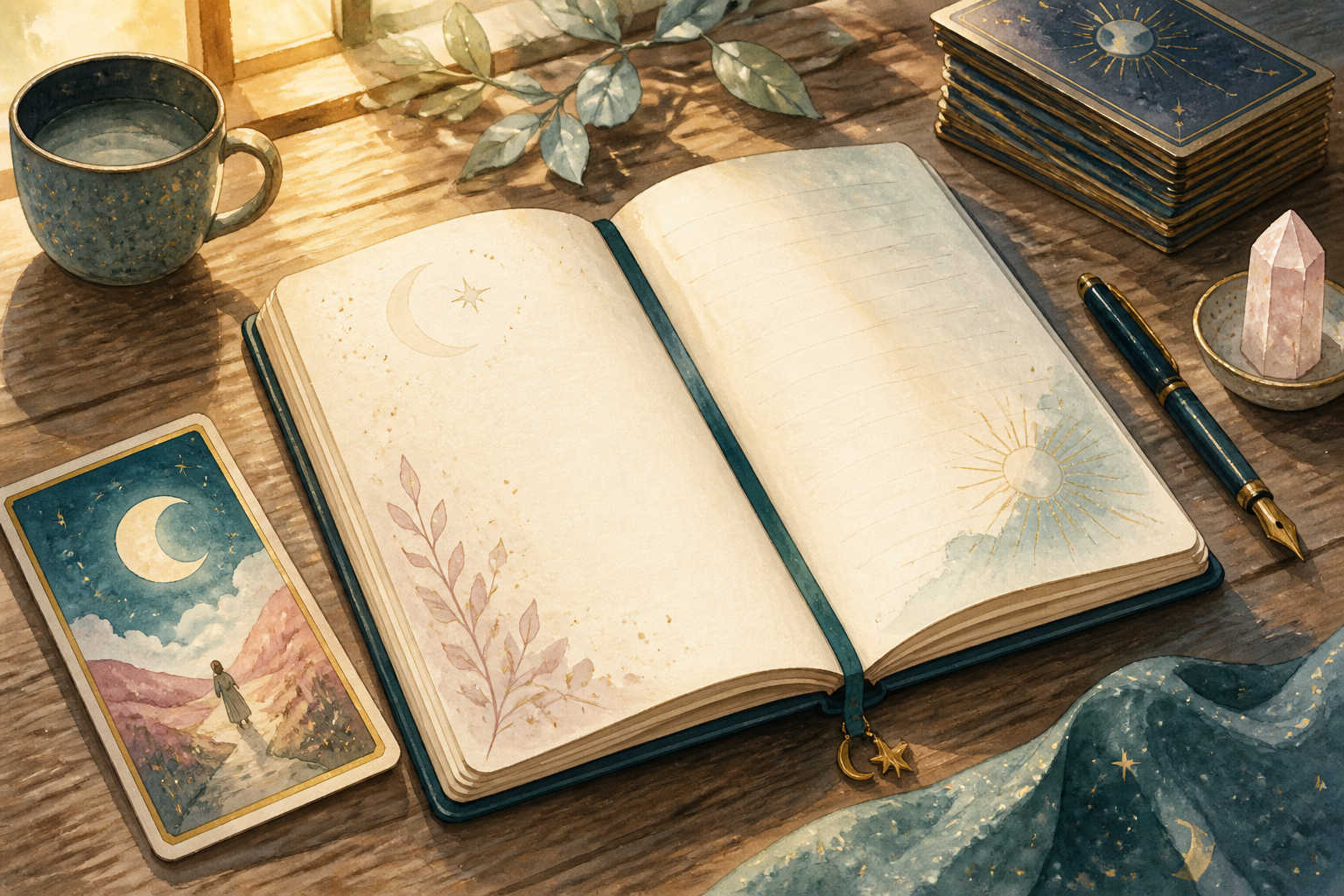
What this article is, and is not
This is not a piece about reading the future. We do not believe a card knows anything about your job interview on Thursday, and we are not going to pretend otherwise. (If you want the broader frame for reading tarot and astrology as entertainment rather than prediction, we have a companion piece.) What a card can do, however, is interrupt the loop you have been in. Eighty-eight percent of the work in self-reflection is just stopping the autopilot for ten minutes. The right prompt at the right moment is one of the cleaner ways to do that.
If you have ever opened a journal and written Day 14: same as yesterday, this is the article for you.
Why tarot, specifically
There are a thousand journaling prompt lists on the internet. Most of them are abstract, and that is the problem. What is one thing you are grateful for? is a fine question, but it is the same fine question every day. Your brain learns the answer shape in three sessions and starts producing it on autopilot. The journal stops doing the thing the journal was for.
A tarot card breaks the autopilot for two reasons. First, the card you draw is random — you cannot pre-decide what kind of question you want today. Second, the imagery is concrete. The Tower and The Hermit and Three of Cups are not interchangeable abstractions; each one has its own visual world. That concreteness is what makes the prompt land somewhere instead of bouncing off.
None of this requires you to believe in the supernatural. You can run the same exercise with a single shuffled deck, a vague memory of what each card traditionally means, and a willingness to be surprised. That is what this guide assumes.
The setup
You need a deck and seven minutes. That is it. No incense, no candles, no special phase of the moon (though if those things calm you down, by all means use them).
Shuffle for as long as it takes for your hand to feel like it is done. People who do this for a long time learn to trust that small okay, that's enough feeling, and it works fine on the first day too. Then draw one card.
Set a seven-minute timer. Open your journal. Look at the card. Pick the prompt below that matches the situation you are actually in.
Prompt 1: When you cannot tell what you feel
Question: Looking at this card, what feeling first shows up in my body?
This is the first prompt because most people, most of the time, cannot tell you what they are feeling. They can tell you what they think they should be feeling, which is a different thing.
The trick is to skip the meaning of the card and go to your body. Does this image make your shoulders drop? Tighten? Does it make your stomach lift, or sink, or feel nothing? You are not analyzing the card. You are using the card as a mirror for what is already happening one inch under your skin.
The useful follow-up: and what would I be doing differently in my afternoon if I admitted that was the feeling?
Prompt 2: When you are stuck on a decision
Question: If this card represented the version of me making this decision, what would I notice about how she or he is doing it?
This one is a small magic trick. You draw the card and pretend it is a portrait of you-mid-decision. Look at the figure (or the imagery, if it is a non-figural card). Is this version of you rushing? Avoiding eye contact? Holding back? Strangely calm?
Whatever you notice, write it down. That is almost always the truth you have been hiding from yourself about how you are actually approaching the decision, regardless of what you have been telling friends.
Follow-up: what would change if she or he made the call from a slightly different posture?
Prompt 3: When something has been gnawing at you
Question: Pretend this card is the part of me that has been quiet about this. What is it trying to say?
We all have a part of ourselves that has known something for a while and has been politely declining to say so. The part that already knew the friendship was off, the job was wrong, the apology was hollow.
Drawing a card and treating it as that part's voice gives the quiet part somewhere to speak from. You are not channeling anything. You are just lending your hand for the next seven minutes.
The rule for this prompt is to write fast and not edit. The first three sentences are usually polite cover. Sentence four is where the actual thing tends to live.
Prompt 4: When you are about to do something hard
Question: Imagine I am about to walk into the hard thing tomorrow. What would I want this card whispered to me on the way in?
This is a quieter prompt and it works better than it sounds. Hard things — a difficult conversation, a presentation, a goodbye, a first day — are easier when you have one specific phrase to walk in with. Just one. Not a speech. Not three principles. One sentence.
Look at the card. Use the imagery. Write the one sentence in the voice of someone who genuinely wants you to do well. Read it out loud once. Save it for tomorrow.
The vast majority of times you will reach for it and it will help. The other times, you will at least walk in noticing that you tried.
Prompt 5: When the day was beautiful
Question: What did this card show up to celebrate?
It is a small thing, but most journaling cultures forget to write down the good days. They were too busy to journal because the day was good, and then the memory blurs into the average of all the other Thursdays.
When a day was beautiful, draw a card and let it stand for the celebrating part of you, not the analyzing part. Write what was good without asking why. Resist the urge to insert a lesson. The lesson will arrive on its own next week, when your brain quietly lines this entry up against the harder ones.
This is also the prompt to use when you don't know what to journal. Today was fine. draws nothing. Today the air smelled like the first week of fall draws something.
A few practical things
One card is enough most days. Three-card spreads are fun once a week. Daily, one card keeps the practice from becoming an analysis hobby that crowds out the real reason you started.
You are allowed to redraw if the first card lands as a wall. Some days a card just doesn't speak. That is normal. Reshuffle and pull again, no ceremony required. Quiet days happen.
Keep a corner of the journal for repeats. The same card showing up across different weeks tends to mean something. You will see the pattern in your own handwriting before you see it anywhere else.
If the imagery scares you, slow down. Cards like Death, The Tower, and the Ten of Swords often look alarming and do not, in tradition, mean what they look like. If a card lands hard, pause. Read its traditional meaning before writing. If it still hits, that is information about what you are carrying — not a warning about the future.
What this practice is, in the end
Nobody who keeps a tarot journal for a year has it because tarot was right about the future. They have it because, three nights a week for a year, a deck of cards forced them to actually answer the question and how do you really feel about that. After a year, your handwriting becomes the most important text in the room.
We do not promise tarot tells you anything. We do promise that a good prompt, on a Tuesday night, can move something that was stuck for weeks. Try one. Save the journal. The journal will do the rest.
Some of the frameworks here are well-researched, some are mostly tradition. The books and studies behind each one — and how solid each is — are listed in our editorial sources.
More from this hub
Tarot and Astrology as Entertainment — A Reader's Guide
Tarot decks and astrology apps are everywhere — and they work best when you read them as imaginative content, not as forecasts. A grounded look at how to enjoy the symbolism, what tips it from play into harm, and how Selvora treats the genre.
Zodiac Compatibility — Entertainment vs Real Relationships
Zodiac compatibility content is fun, visually rich, everywhere. This separates what the tradition is doing from what real relationships need — and how to enjoy one without quietly replacing the other.
Astrology Content — How to Enjoy It Without It Running You
Astrology is everywhere — short, visually pretty, sometimes uncannily specific. For the reader who likes it and wants a clear, non-moralizing guide to keeping it in the healthy zone.