Tarot Minor Arcana — The Four Suits (Cups, Wands, Swords, Pentacles) at a Glance
The 56 Minor Arcana cards and four suits at a glance — what Cups, Wands, Swords, and Pentacles govern, how the numbered pips progress, and how to read the court cards.
Finished the Majors? The Minors are next
Of the 78 tarot cards, 22 are the Major Arcana — the "great secret" cards that handle life's big turning points and spiritual themes. Once you've learned those 22, the natural next step is the other 56: the Minor Arcana. If the Majors are the chapter titles of a life, the Minors are the everyday sentences that fill those chapters. The morning-commute irritation, the made-up fight with a friend, the feeling of checking your bank balance, the spark of a new idea — all the daily texture the Majors skip lives here. If the 22 Majors are hazy, the Major Arcana guide is a good refresher first.
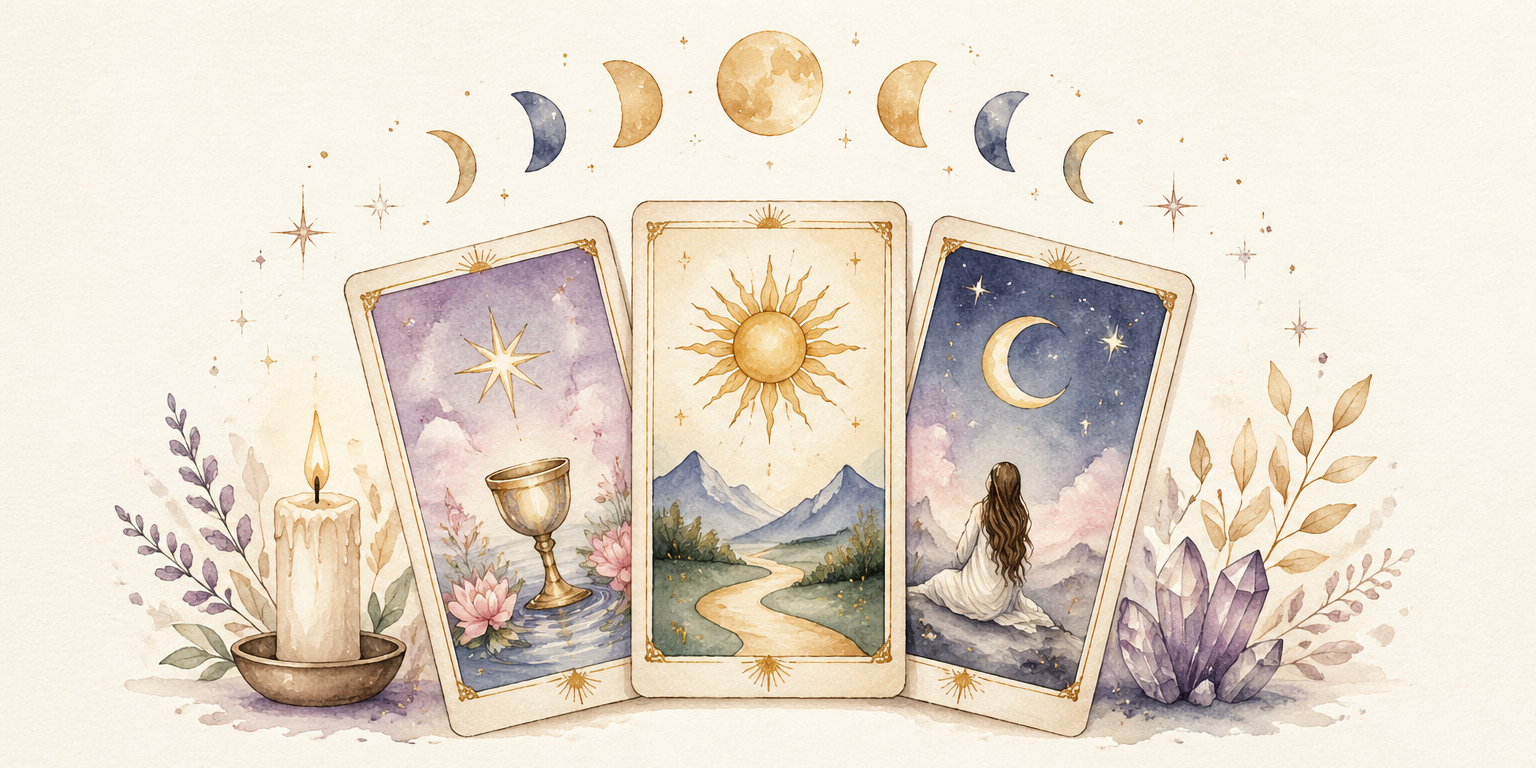
The 56 Minors split into four suits, like the hearts and spades of playing cards. Each suit has ten numbered cards (Ace through Ten) plus four court cards (Page, Knight, Queen, King). Each suit governs one area of life.
Cups — emotion and relationships (Water)
Cups are the suit of the heart, element water. Love, friendship, family, feeling, intuition, connection — everything felt in the chest belongs to Cups. A reading heavy with Cups is usually asking "how is your heart right now?" The Two of Cups is the moment two people click; the Ten of Cups is the fullness of family; the Five of Cups is grief over what was lost. In everyday terms, Cups is the thermometer of relationships and feelings.

Wands — drive and creativity (Fire)
Wands are the suit of fire: passion, drive, creativity, momentum, fresh starts — the place where the chest goes hot with "I want to do this!" Lots of Wands usually means a story about energy and action, projects and challenges. The Ace of Wands is the spark of a just-born idea; the Eight of Wands is things moving fast; the Ten of Wands is the burnout of carrying too much. In everyday terms, Wands is wanting something and the force to push it forward.
Swords — mind and conflict (Air)
Swords are the suit of air: thought, logic, truth, decisions, and the conflict and stress that come when those thoughts collide. Tarot's most "painful" cards cluster in Swords, which scares some beginners — but Swords isn't the "bad suit," it's the suit of the mind. It just honestly shows that most of our suffering actually starts in our thinking. The Ace of Swords is the blade of clear insight; the Three of Swords is heartbreak; the Ten of Swords is rock bottom that's also an ending and a beginning ("nowhere to go from here but up"). In everyday terms, Swords is thoughts, words, and decisions.
Pentacles — money, body, the material (Earth)
Pentacles (or Coins) are the suit of earth: money, work, health, the body, home — all the tangible, real-world stuff. The most "grounded" suit, not flashy, but it handles the foundation that holds a life up. The Ace of Pentacles is the seed of a new opportunity or resource; the Eight of Pentacles is the craftsperson quietly honing a skill; the Ten of Pentacles is long-built stability and legacy. In everyday terms, Pentacles is money, work, body, and security.
What the numbers (Ace–Ten) tell you
Within each suit, Ace through Ten isn't a random pile — it's a small growth story. The Ace is the seed of that domain, pure possibility just handed to you. The middle numbers are what that seed goes through as it grows. The Ten is that domain at its fullest — either complete, or so full it overflows. So rather than memorizing "Three of Cups," read it as "around stage three of Cups (emotion) — the place of celebrating together." Low numbers lean toward beginnings, high numbers toward ripeness. Grab just that one instinct and the 40 numbered cards turn from things to memorize into things you can read.

Court cards — Page, Knight, Queen, King
Each suit has four people — the court cards — usually read two ways: as a person, or as an energy.
- Page: the beginner, student, or messenger of the suit. The thrill of just starting to learn; news that's just arrived.
- Knight: the one who pushes the suit into action. Energy charging in one direction (sometimes too hard).
- Queen: the one who holds and ripens the suit from within. A mature, nurturing quality.
- King: the one who completes the suit outwardly. A responsible, governing quality.
So the Queen of Cups is an emotionally deep, empathetic person (or that energy), while the King of Swords is a logical, decisive person (or that stance). When you can't tell who a court card points to, ask both questions at once: "is this naming a person, or naming a quality I need to step into right now?"
The four suits in one line
A one-line summary to reach for when you're stuck:
- Cups = the heart. "How does this feel?"
- Wands = drive. "What do I want to do?"
- Swords = the mind. "How do I judge this?"
- Pentacles = the material. "How does this actually play out in real life?"
Hold those four questions and even an unfamiliar card lets you grab its texture — "ah, this is a heart question."
Reading the "missing suit"
Whether you've laid three cards or five, which suits showed up — and which suit didn't appear at all — is a surprisingly big hint. If it's all Swords (mind) and not a single Cup (emotion), that can be a sign: "I'm running everything through my head right now and not looking at my heart." If Pentacles (the material) is missing, you might ask, "big dreams, but are my feet on the ground?" Noticing which suit is empty, alongside which suits are present, makes a reading far more dimensional.
What the Minors fill in + closing
If the Major Arcana speaks of "fateful big events," the Minor Arcana speaks of the real life in between. Most days aren't the day the Tower falls or the World completes — they're filled with a Cup's worth of tenderness and a few Pentacles' worth of worry. So learning the Minors makes a reading far more specific and warm.
For your next step, carry on to how these cards are arranged and read — the three-card spread guide. If you need more of the basics, the beginner's guide to tarot is there. And to actually lay three cards out yourself, you can practice with a three-card tarot reading right away.
For the record — the suit meanings here follow the traditional conventions of the 1909 Rider-Waite-Smith (RWS) deck; details vary deck to deck. And as always, tarot is a tool for entertainment and self-reflection — not supernatural prophecy, but a mirror for the present you.
Some of the frameworks here are well-researched, some are mostly tradition. The books and studies behind each one — and how solid each is — are listed in our editorial sources.
Take the quiz
Three-Card Tarot Reading
Reading about it is good — finding your own result is better.
Related Articles
Major Arcana Tarot Cards: Complete Meanings Guide
A comprehensive guide to all 22 Major Arcana tarot cards — upright and reversed meanings, history of tarot, and practical reading tips for beginners.
Read More
Tarot for Beginners: How to Start Reading Cards
A complete beginner's guide to tarot cards. Learn how to choose your first deck, master basic spreads, develop your intuition, and avoid common mistakes.
Read MoreHow to Read a Three-Card Tarot Spread — Past, Present, Future as One Sentence
How to read a three-card tarot spread — past/present/future layouts, how position changes a card meaning, reading three cards as one connected story, reversals, and beginner pitfalls.
Read More