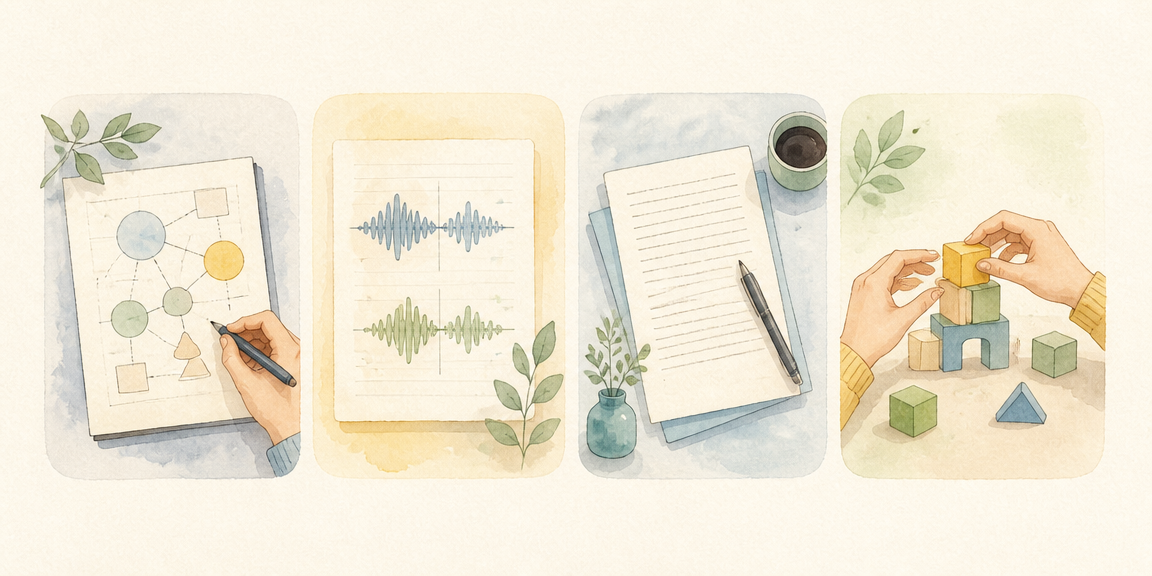
VARK Learning Styles: How to Study With the Way Your Brain Actually Works
Visual, auditory, reading-writing, kinesthetic — practical study strategies for each VARK style. Knowing your dominant mode changes what you get from the same hours.
You've probably had the experience of studying hard for something and getting mediocre results — and watching someone else study less and do better. Some of that gap really is just luck, but a big chunk of it comes down to whether your study method matches the way your brain prefers to take information in. The same two hours can mean very different things to two different brains. One person retains a chapter best by reading it once carefully. Another person retains the same material best by watching a video and sketching diagrams. A third person needs to argue about it out loud.
The most widely used model for this is VARK, developed by educator Neil Fleming in the late 1980s. The acronym stands for Visual, Auditory, Reading-Writing, and Kinesthetic — four broad preferences for how people take in new information. The academic community has reasonable skepticism about the stronger claim that "matching teaching to learning style improves outcomes," but the gentler claim — knowing your own dominant input style helps you spend your study hours better — is something most learners can confirm from experience. This guide walks through each of the four modes, what they look like in real life, and the specific study tactics that actually work for each one.

🎨 The Visual Learner — A Brain That Runs on Images
Visual learners absorb information best when it has a shape they can see. Diagrams, color, arrows, mind maps, well-designed slides. A page of pure dense text feels like words floating around with no anchor. The same content with structure, color, and spatial layout suddenly clicks. On a test, you often remember not just the answer but the rough page location where you saw it — top-left of the right-hand page, with a highlighter mark. That's the visual brain at work.
Tactics that actually work for you:
- Convert paragraphs into diagrams. Five minutes of turning text into boxes and arrows usually beats thirty minutes of re-reading.
- Use color sparingly and consistently. Two or three colors with stable meaning (definitions in blue, examples in green, exceptions in orange) — full rainbow highlighting becomes noise.
- Equal-length video usually outperforms equal-length text for you. Prioritize video lectures, sketchnoting walkthroughs, and documentary-style overviews when available.
- During audio-only lectures, sketch as you listen. A purely auditory input leaves your visual processing half-asleep, and you'll retain less.
Watch out for: Visual learners can fall in love with the aesthetics of their notes — gorgeous handwriting, perfect calligraphy, color-coded everything — without the notes actually pushing their understanding forward. Don't mistake "the time I spent making the diagram beautiful" for "the time I spent thinking." A clear, ugly five-minute sketch that changes your understanding is more valuable than an hour-long beautiful one that just reorganizes what you already knew.
🎧 The Auditory Learner — A Brain That Needs Voice
Auditory learners process information best through sound. The same material lands twice as hard when someone explains it out loud, and discussion-based or lecture-based classes suit you naturally. Even alone, you might mouth words while reading silently, read passages out loud under your breath, or play recorded material in the background while doing chores. People sometimes assume this is a tic to suppress; for an auditory learner, it's actually the processing pipeline itself. Suppress it and you lose efficiency.
Tactics that actually work for you:
- Read your hardest material out loud. It feels strange the first few times, then becomes one of your most effective tools.
- Record yourself summarizing a topic in your own words for one minute, then play it back the next day. That one move often beats hours of silent re-reading.
- Use the Feynman technique: pretend you're teaching the concept to a friend or family member. Pay close attention to where your voice stalls — that's where your understanding actually has a gap.
- Podcasts, audiobooks, and recorded lectures are your goldmine. Commute time can become study time without effort.
Watch out for: Auditory learners often confuse "I've heard this several times" with "I understand this." Familiarity is not fluency. If you can follow a podcast on a topic but can't explain the same topic back out loud without notes, you're still in the listening phase. The locking-in step is deliberately speaking it back in your own words, on purpose, not just receiving more input.

📝 The Reading-Writing Learner — A Brain That Thinks in Sentences
Reading-writing learners absorb best when material moves through the written word, and they cement their understanding by writing it back out themselves. The old advice to "rewrite your notes three times" gets shrugged off by most learners, but it genuinely works for you, because the act of rephrasing on the page is doing the thinking. Your notebook — physical or digital — functions as a true second brain, and you can usually find the exact paragraph from two weeks ago because it's in your own words.
The traditional education system is built around the assumption that everyone learns this way: textbooks, essays, written exams, structured outlines. If you're a reading-writing learner, school probably felt natural for you in a way many of your friends found strange.
Tactics that actually work for you:
- Don't copy slides verbatim. Take notes in your own phrasing. Verbatim copying is significantly weaker for retention.
- Summarize each section in three sentences before moving to the next. The places where the summary feels awkward are exactly the places you don't actually understand yet.
- Build an outline, then collapse it into a one-page cheat sheet. The compression process is where the real signal-to-noise gets sorted.
- Make your own flashcards in your own words. Pre-made decks are inferior for you because the wording isn't yours.
Watch out for: Text-heavy learners can drift into "I read it, therefore I know it." Reading is passive input. Writing it back out is the active step that locks it in. Also, you may quietly under-use visual aids and hands-on practice because you trust paragraphs more than diagrams. For inherently visual or kinesthetic topics — anatomy, mechanical systems, sports techniques, code architecture — your text-only strategy hits a ceiling. Watch a video at least once, or try a real example, before going back to your notes.
🛠️ The Kinesthetic Learner — A Brain That Needs the Body
Kinesthetic learners experience concepts as abstract and slippery until their body gets involved. You can read about something and understand it in theory, but the moment you try it — even badly — the meaning lands. You likely learned to drive faster than your friends, picked up a new sport in adulthood and got weirdly good at it, or built a working prototype of something while everyone else was still in the planning stage. Sitting still through a long lecture is genuinely painful for you, not because you don't care but because your brain runs through your body, and a still body is a quiet brain.
This style is underrated in traditional classrooms and powerful in real-world contexts. Apprenticeships, lab classes, sports, music with an instrument in hand, cooking, hands-on design — they all play directly to your strengths.
Tactics that actually work for you:
- Forget the 90-minute reading block. Break study into 25-minute chunks with stretching or walking in between, and your retention jumps.
- Make abstract concepts physical. Sort flashcards into stacks. Walk around your room while reciting. Use hand gestures to represent ideas. Associate concepts with specific locations.
- Prioritize real examples over hypothetical ones. If you're learning to code, write a small program. If you're learning marketing, analyze a real ad. The fake version doesn't activate your learning the way a real one does.
- Seek out simulations, labs, apprenticeships, and internships. These structured hands-on learning environments are your true mode.
Watch out for: Kinesthetic learners can mistake "I got it to work" for "I understand the principles." Trial and error gets you to a working version fast, but if you don't take one minute afterward to write down why it worked in one sentence, you'll find yourself solving the same problem from scratch later. Pair every hands-on session with a quick reflection: "What did this just teach me, in one sentence?" That one sentence is the bridge between experience and transferable understanding.
✨ Are You Stuck With One Style Forever?
No. People have preferred input modes, but almost nobody is locked into one. The typical pattern is one or two dominant styles supported by the others — visual with kinesthetic support, auditory with reading-writing as a backup, and so on. VARK isn't an identity. It's a starting point for designing your study strategy.
Knowing your style changes two things. First, you prioritize differently. A visual learner spends time on videos first. An auditory learner spends time on lectures and discussions first. A reading-writing learner builds from textbooks first. A kinesthetic learner starts with practice problems first. The hours haven't changed; the order has. Second, you can deliberately strengthen your weaker modes. A kinesthetic learner who ignores written material altogether will hit a ceiling. A reading-writing learner who never tries practical exercises will plateau too. The growth move is to keep your strong mode as the default and consciously practice your weakest one a little each week.
💛 Wrapping Up — What's Your Style?
A ten-question quiz can give you a quick read on your dominant mode. Treat the result less as a verdict and more as an excuse to look at your study habits with fresh eyes. Self-knowledge is where the real efficiency gain starts.
👉 Take the Learning Style (VARK) Quiz
A few related pieces worth reading next:
- 🎯 How accurate are personality and learning quizzes, really?
- 🧠 Emotional Intelligence (EQ) — the other axis of self-understanding
- 📝 Applying quiz results to your daily life
Note: VARK is not a model that claims learning styles strictly determine learning outcomes — there's reputable academic research pushing back on the stronger version of that claim. So use this guide as a starting point for examining your own study habits, not as a fixed label. It's a tool for experimenting with what actually works for you, not a verdict about who you are.
Some of the frameworks here are well-researched, some are mostly tradition. The books and studies behind each one — and how solid each is — are listed in our editorial sources.
Take the quiz
What's Your Learning Style? 📚✨
Reading about it is good — finding your own result is better.
Read the in-depth guide
Psychology Guide
Related Articles

Emotional Intelligence (EQ): The 4 Domains and How to Use Them in Real Life
Emotional intelligence isn't a fixed trait — it's four trainable muscles. A practical guide to self-awareness, self-management, social awareness, and relationship management.
Read More
Free Psychology Quizzes: Discover Your Hidden Self
Explore scientifically-backed personality tests including Big Five, MBTI, Enneagram, and DISC. Learn how each assessment works, their strengths and limitations, and which one is right for you.
Read MoreFree Psychology Quizzes: Discover Your Hidden Self
Explore scientifically-backed personality tests including Big Five, MBTI, Enneagram, and DISC. Learn how each assessment works, their strengths and limitations, and which one is right for you.
Read More