How to Take a Couple Quiz Without Starting a Fight
Compatibility quizzes are great date-night fuel — until one answer goes sideways. A short, practical guide for couples who want fun without fallout.
The pattern
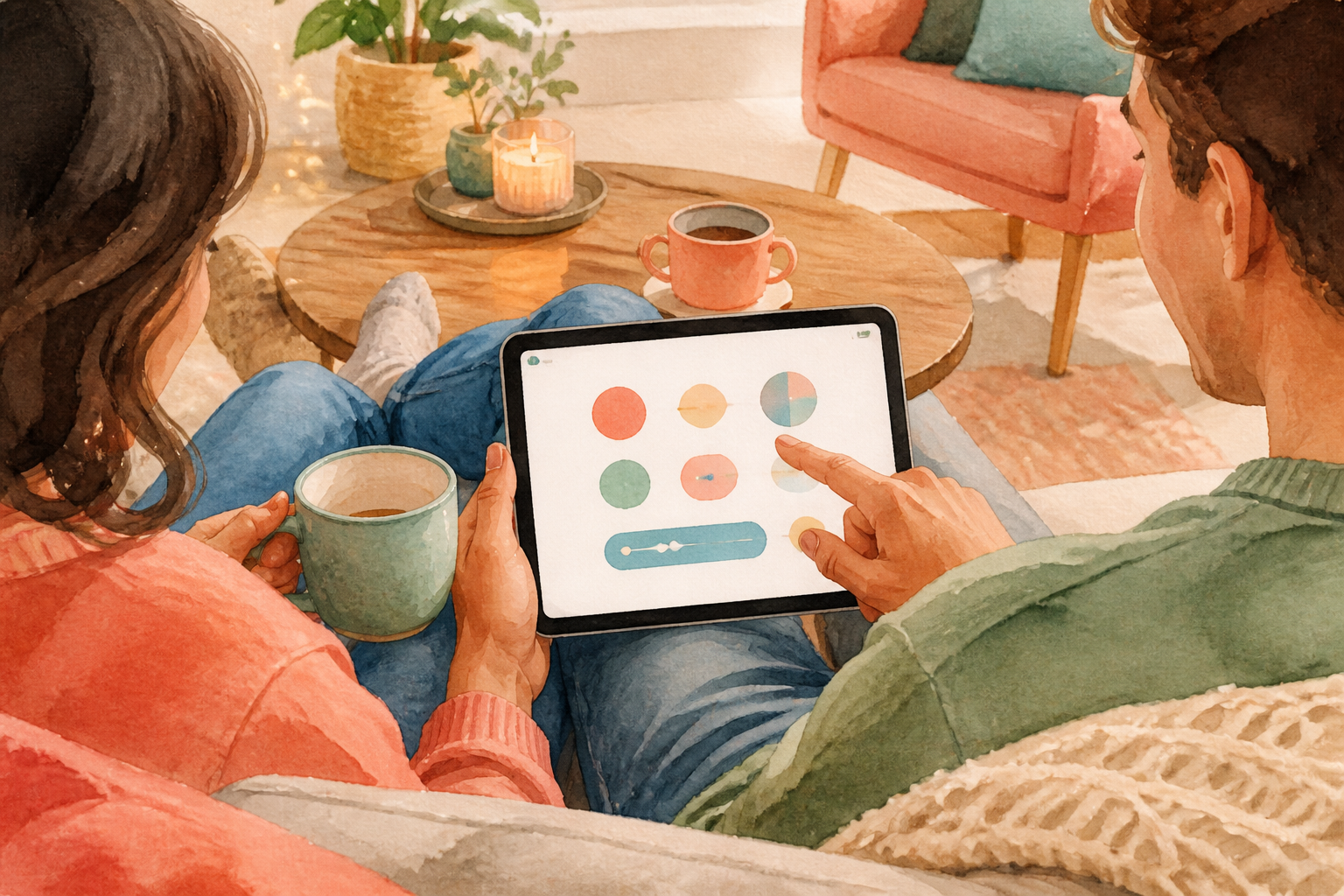
It is 10pm on a Saturday. You are on the couch. Someone says let's do that couple quiz everyone is doing, and twenty minutes later there is a strange silence in the apartment. The quiz did not lie about anything. It simply asked one question that landed wrong, and now you are both thinking, very carefully, about whether to let it go or not.
This is so common that it is almost a genre. We do not want to make Selvora's quizzes worse to avoid it, but we can offer a small framework for taking them better. The trick is mostly about what you set up before you start, not about which answers you choose.
Why couple quizzes go sideways
A couple quiz is doing two things at once. On the surface it is asking light questions. Underneath, it is asking each of you to say something out loud about the relationship in front of the other person. The first part is fun. The second part is what most couples are not used to doing without a glass of wine and a long preamble.
Specifically, things go sideways when the quiz forces a choice on a topic where:
- you each thought the other person had a different answer than they actually do
- one of you has a complaint that has been waiting for an opening
- one of you reads a multiple-choice question more literally than the other
The answers are not the problem. The problem is that the quiz is now the polite cover for a conversation neither of you scheduled. With a little setup, that conversation can be a good one. Without setup, it tends to leak as resentment.
A two-minute pre-game
Before you start the quiz, do two tiny things.
One: agree on a tone. Say something like let's do this for fun, and if anything weird shows up we will talk about it tomorrow, not tonight. That sentence does an enormous amount of work. It promises the conversation will not get hijacked by an answer, and it gives both of you a graceful exit if a question lands hard.
Two: agree on a stop word. Pick one word — pause is fine — that either person can say to skip a question without explanation. Quizzes are voluntary. Most couples have never given themselves explicit permission to skip a question without a reason, and that single permission removes a lot of pressure.
That's it. Then start.
A few things that consistently help during the quiz
These are not rules. They are just the things that come up when couples tell us how their quiz nights went.
Take turns reading questions out loud. Reading takes the steering wheel away from the screen. The pace gets a little gentler, and small clarifications happen naturally — wait, what did you mean by 'often'? — instead of stewing inside one head.
Don't pre-guess each other's answer. It is tempting to say you are going to pick C before they pick. It is also a small trap. If they were leaning B and now feel watched, they will pick C just to avoid the discussion. You will not have learned anything. Let them go first, then react if you want.
Compare your answers, but don't grade them. Oh, I was sure you would say more often is fine. That is the wrong answer is not fine, and you can tell the difference instantly when you hear it.
Treat any "oh" with curiosity, not defense. When your partner says oh in a particular tone, that is real information. The reflex is to defend or apologize. The better move is what was the 'oh'? — said warmly. Half the time it is a tiny preference they had not realized was a preference. The other half is a thing worth talking about, and you just made room for that.
What to do if a question hits a nerve
Sometimes a question lands on a topic that is bigger than the quiz. How often do you feel emotionally supported? is technically a five-choice multiple-choice question, but it is also a paragraph from the conversation you have been postponing.
When that happens, you have three options, and all three are okay.
First, you can pause. Use the stop word. The quiz will wait. If both of you genuinely want to keep playing, come back tomorrow.
Second, you can answer honestly and then explicitly mark the answer as something I would like to talk about properly later. Saying that out loud changes the shape of the silence afterwards. The thing is no longer hiding inside the quiz; it is on the table, with a date.
Third, you can have the conversation right now if both of you have the energy and you both want to. If only one of you wants to, defer. A real conversation that one person was dragged into is a worse outcome than no conversation tonight.
The thing not to do is answer carefully and pretend the answer didn't matter. That is the move that turns a date night into a strange Sunday.
How to read the result
The last twenty seconds of a couple quiz are usually the riskiest. The score appears, the description scrolls in, and one of you reads the headline before the other does. There is a tiny window where someone could say see, told you we're a 7 in a way that lands as we are insufficient.
The healthy version is to read the result in two passes. First pass: read the strongest sentence in the description out loud. Just one. Whichever line caught both your eyes. Talk about that for a second.
Second pass: notice what is missing from the result. Compatibility quizzes work with patterns; they cannot see your specific year together, your specific apartment, the way one of you makes coffee for both of you on Sunday. The result is a generalization; the relationship is the specific. The point is to use the generalization to notice the specific, not the other way around.
If the headline number is low, that is also fine — and frankly, more interesting. A low score on a quiz like this almost always means the two of you are answering honestly about a place you already noticed friction. You can use that as content for tomorrow's conversation, or you can let it sit. You do not have to fix it tonight.
A note about the more serious quizzes
There is a difference between what color is your love-aura together and what is your attachment style as a couple. The first is light Saturday content. The second is closer to a real reflection tool. We try to label that difference clearly on Selvora — entertainment-first quizzes get a different intro from quizzes inspired by attachment theory or love languages — but it is worth noticing yourself.
If the quiz you are about to take has the word attachment or style or language in it, you might want a slightly longer pre-game and a slightly more open evening afterwards. Those quizzes earn a different ceiling: not therapy, but more than a meme. Plan accordingly. (For the broader question of what a compatibility score is actually measuring — and what it can't see — see How to Read a Romantic Compatibility Test Without Hurting Anyone.)
And a tiny love letter
The couples who get a lot out of these quizzes are not the couples who agree most often. They are the couples who have a graceful way of saying huh, I didn't know that about you across the table. Most of the work is making it safe to say that sentence at all.
You can have that, too. The quiz is just an excuse. The setup is the actual gift.
Some of the frameworks here are well-researched, some are mostly tradition. The books and studies behind each one — and how solid each is — are listed in our editorial sources.
More from this hub
Attachment Styles, Explained Simply
Attachment theory started in a hospital with infants and has traveled a long way into dating apps and group chats. The four common styles in plain language, with a case for reading them gently.
Why "Ideal Type" Quizzes Are So Hard to Stop Sharing
Ideal-type quizzes are one of the most shared formats online. An honest look at why they're so fun, what needs they speak to, and the small ways they can nudge you somewhere unhelpful if used without care.
Self-Reflection Questions for Better Relationships
A collection of honest, specific questions that help you see your own part in how your relationships go. Made for a quiet evening with a notebook, or a calm conversation with someone you trust.