A Beginner's Map of Online Personality Frameworks
A calm tour of the frameworks you keep meeting online — MBTI, the Big Five, Enneagram, attachment theory, love languages, zodiac — with a plain-language take on what each is, where it's useful, and where it gets oversold.
Why this guide exists
If you spend any time at all on personality content online, you'll meet a handful of frameworks within a week. Someone's profile says INFJ. A friend mentions their love language. An article references attachment theory. A group chat spirals into an argument about whether Capricorns are actually cold.
Each of these comes from a different intellectual lineage and was built to answer a different question. Treating them all as slightly varied flavors of "the vibes thing people do online" is how you end up confused — or worse, over-committed to whichever one you encountered first.
This article is a plain-language survey designed to help you locate each framework on a shared map. No cheerleading, no dismissing. Just a short, honest read so the next time one of these comes up, you know what it is and what to do with it.
MBTI (Myers-Briggs Type Indicator)
What it is. A personality type system that sorts people into 16 types along four axes — extraversion vs introversion, sensing vs intuition, thinking vs feeling, judging vs perceiving. Built on top of Carl Jung's theory of psychological types and popularized in the mid-twentieth century by a mother-daughter team.
What it's for. Vocabulary. It gives people a shared, low-stakes way to talk about human difference. Most useful for self-reflection ("oh, that's why I drain so fast at networking events") and team-level language ("we clash on S vs N").
Where it over-reaches. It doesn't predict job performance reliably (see the workplace-specific limits), it isn't a clinical diagnostic, and its forced four-way structure doesn't match how real personality traits are distributed. Use it as a sketch, not a fingerprint.
The Big Five (OCEAN)
What it is. Five continuous personality dimensions — openness, conscientiousness, extraversion, agreeableness, neuroticism — each of which you sit somewhere along a spectrum of. Built through decades of statistical personality research.
What it's for. Being the closest thing personality psychology has to a research-backed everyday framework. Researchers use it because the dimensions replicate across cultures and over time. It's less culturally fun than MBTI — five sliders are harder to meme than 16 types — but it holds up better in a lab.
Where it over-reaches. The Big Five describes tendencies, not destinies. High conscientiousness doesn't guarantee you'll be reliable on a bad week; low agreeableness doesn't mean you can't be kind. The dimensions are useful starting points, not life scripts.
Enneagram
What it is. A personality system of nine core types, each organized around a specific core fear and desire. Concepts like "wings" and "stress and growth arrows" add dynamism — describing how a type shifts under pressure or in growth.
What it's for. Motivational self-understanding. The Enneagram centers why — why you keep being drawn to that kind of work, that kind of partner, that kind of fight. Many people find it the most personally useful framework because it captures patterns MBTI tends to miss.
Where it over-reaches. Enneagram has weaker scientific validation than the Big Five or even MBTI, and many popular descriptions blend spiritual claims with personality description without labeling which is which. Use the motivational insight, and stay skeptical of anyone presenting the types as metaphysical truth.
Attachment theory
What it is. A framework describing how people form emotional bonds, sorted into four common adult styles — secure, anxious, avoidant, fearful-avoidant. Originally developed from research on infants and their caregivers.
What it's for. Understanding your own patterns in close relationships — how you handle distance, how you seek closeness, what stresses you out in romantic or family dynamics.
Where it over-reaches. Online attachment quizzes aren't clinical assessments. Styles can shift across relationships and across time. And attachment language has a tendency to get weaponized online — "avoidant" and "anxious" used as insults rather than as descriptions. That's a misuse of a genuinely useful framework.
Love languages
What it is. A popularized framework that sorts expressions of affection into five categories — words of affirmation, acts of service, receiving gifts, quality time, physical touch.
What it's for. Translating mismatched ways of showing care. Best use: "we keep missing each other because I show love through X and you receive it best through Y."
Where it over-reaches. The neat division into exactly five categories is more pop than science, and treating it as if each person has one stable "primary" language oversimplifies. Use it as a conversation starter, not a diagnosis of why your partner is or isn't loving you correctly.
Zodiac and astrology
What it is. A centuries-old symbolic tradition that uses celestial body positions at your time of birth to describe personality tendencies, cycles, and compatibilities. Most app content focuses on the sun sign; fuller practice uses moon, rising, and the whole chart.
What it's for. A rich symbolic language for talking about moods, patterns, and relational dynamics. For some people, a journaling anchor. For most, a fun, community-shared vocabulary.
Where it over-reaches. There's no reliable scientific evidence that zodiac signs predict personality, compatibility, or future events. When astrology gets used to decide big life choices or filter potential relationships, it tends to cost more than it gives back.
A few frameworks you'll see less often
You'll also run into, in roughly this order of how common they are: DISC (workplace-focused four-category system, useful for team communication, less useful for personal depth), HEXACO (a six-factor Big-Five-adjacent model used in research), various "cognitive functions" deep-dives inside MBTI (real to serious fans, mostly invisible to casual ones), Human Design (a modern synthesis of astrology, I Ching, and chakras with no scientific validation but a strong aesthetic), and occasional throwbacks like Temperament Theory (sanguine / choleric / melancholic / phlegmatic — older than any of the modern frameworks and mostly surviving because the terms are fun).
You don't need to know all of these. Recognize them in the wild and place them on the same map as MBTI, Enneagram, and zodiac: they describe tendencies, they aren't diagnostic instruments, and the craft of using them well is in reading them lightly.
How to pick one to learn first
If you want to dig into a framework, match it to the question you're actually asking.
If you want a vocabulary for cognitive style — how you gather information and make decisions — start with MBTI. It's the most social and the most fun to share.
If you want a tool for long-term self-work and growth — what patterns you're stuck in, and why — start with the Enneagram. It tends to be more personally useful than socially fun.
If you're navigating relationships, attachment styles and love languages are your most direct pair. Less exotic, more actionable.
If you want something rigorous — closer to how research psychology actually describes personality — the Big Five is the best entry point, though it has fewer compelling memes and takes longer to warm up to.
If you want imagery and ritual, astrology offers that. Just hold it gently. It's a symbolic language, not a forecasting one.
A final note about collecting frameworks
A failure mode worth noticing in yourself: it's possible to end up with a collection of frameworks that explain everything and change nothing. You know your MBTI, your Enneagram type, your wing, your attachment style, your love language, your sun, your moon, your rising — and your life still has the same shape it had five years ago.
That's a signal to stop collecting and start practicing. Pick one or two frameworks that feel most true, and use them as a prompt to change one small pattern in the next month. It's the practicing, not the collecting, that actually moves a person.
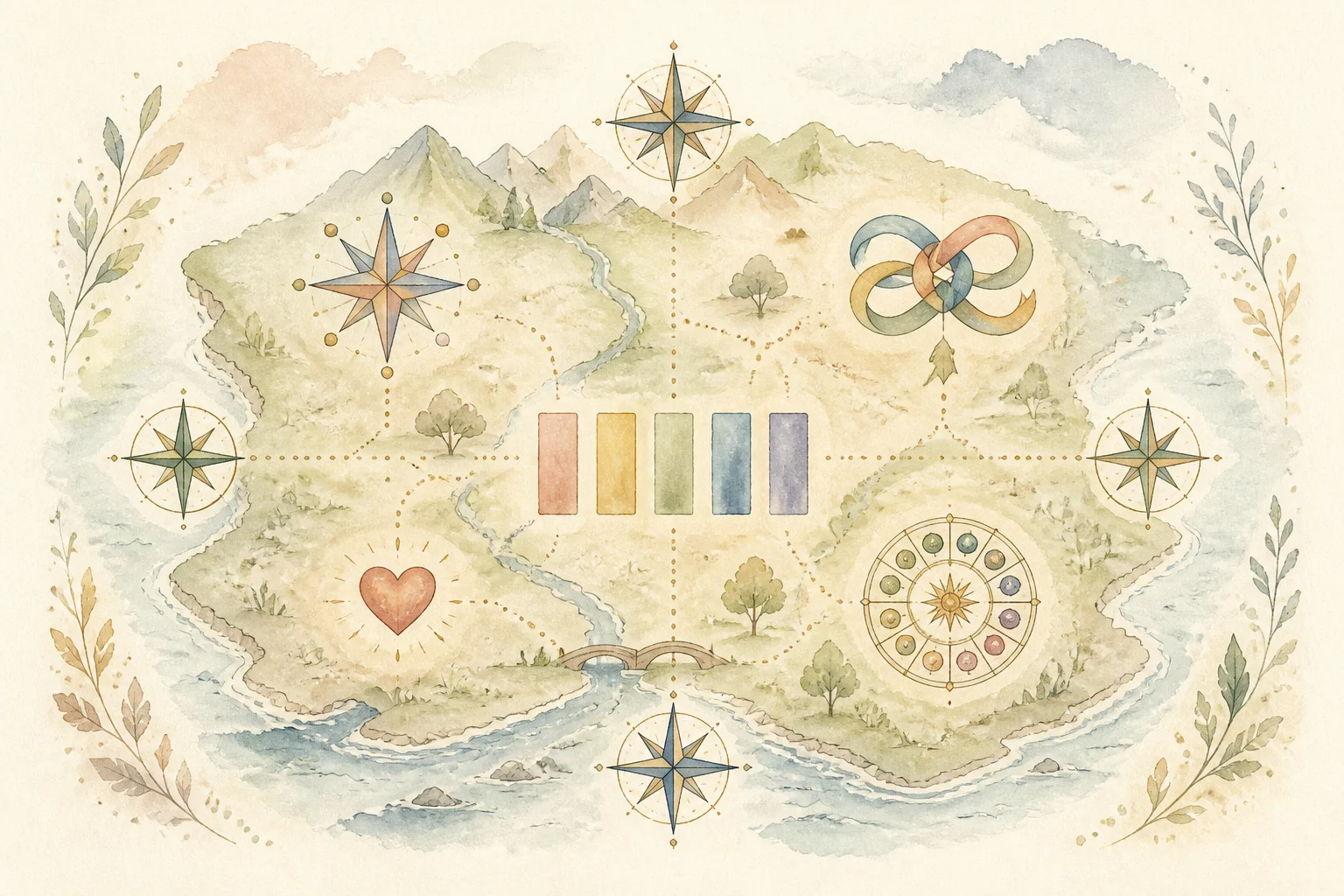
The map is not the territory. The frameworks are maps. The person you are is the territory — bigger, messier, and more interesting than any framework can fully see.
How Selvora chose which frameworks to cover
We deliberately don't cover every framework on Selvora. The ones we build quizzes and hubs around are the ones where (1) the shared vocabulary is genuinely useful in adult life, (2) we can write a result description that reads like a friend rather than a horoscope, and (3) we can honestly label the limits.
So on Selvora you'll find Discover Your MBTI Type, What's Your Enneagram Type?, What's Your Attachment Style?, What's Your Love Language?, and zodiac/tarot features — because those are the frameworks where the three criteria above line up. You won't find a Selvora quiz for the Big Five, because an honest Big Five result needs a longer, norm-referenced instrument than our format supports; we point to it as the more research-grounded option in the same hub. You won't find Human Design or DISC quizzes, because the former has no research backing and the latter is a workplace-specific tool that doesn't fit our entertainment-first voice.
If you're picking which hub to explore next: the Personality hub is the most general; the MBTI and Enneagram hubs are deeper single-framework dives; Relationship Dynamics pairs attachment and love-language content for couples reading together; Astrology keeps the symbolic/reflective material separate so it's never mistaken for prediction.
Honest limits of our catalog. We rotate quizzes and essays over time. If a framework you care about is missing, that usually means we haven't found a way to write it without either over-claiming or under-serving the reader. The Contact page is linked in the footer — if there's a framework you think deserves the treatment, let us know.
Some of the frameworks here are well-researched, some are mostly tradition. The books and studies behind each one — and how solid each is — are listed in our editorial sources.
More from this hub
Should You Take a Personality Quiz When You're Moody?
Mood bleeds into every answer you give. Here's how to read a personality quiz result without mistaking a bad Tuesday for a permanent identity.
How People Actually Use Personality Tests for Self-Reflection
Personality tests are at their best when they prompt reflection rather than deliver verdicts. A walk through the modes people actually use them in, the common traps, and a few small habits that turn a result into something useful.
How to Journal After a Personality Test (in 10 Minutes)
A quiz result evaporates within a day unless you do something with it. A small, low-pressure journaling routine that turns the result into reflection instead of a notification you already forgot.