Reading Tarot as a Mirror, Not a Crystal Ball: A True Beginner's Start
Read tarot as a mirror for reflection, not prediction. Major vs Minor in plain terms, a real three-card walkthrough, reversals, and journaling prompts.
A Card on a Tuesday Night
I still remember the first tarot card I ever pulled. A friend fanned the deck across her kitchen table and said "pick one," and honestly, I was nervous. I kept thinking, what if I draw something awful. Like the Death card. And of course, that is exactly what I drew. My friend laughed and said, "That doesn't mean you're dying. It means something's ending so something new can start." One sentence, and the whole thing flipped for me.
Let me be clear about the most important idea up front: tarot is not a tool for predicting the future. It is closer to a mirror. It takes the half-formed thoughts floating around your head and pins one of them to a picture, so you can finally look at it and go, "oh, so that's what I've been chewing on." The card does not hand you an answer. You pull the answer out of yourself while looking at the card. That distinction is the entire thing.
This is written for someone who knows nothing. Zero. I am not going to tell you to memorize all 78 cards. Relax and follow along.
Major vs Minor, in Plain Terms
A tarot deck has 78 cards, split into two groups: the Major Arcana (22 cards) and the Minor Arcana (56 cards).
Here is the simplest way I know to think about it. The Major cards are like chapter titles of a life. A fresh start (The Fool), a collapse and rebuild (The Tower), the closing of a whole cycle (The World). They are the big plot beats. When several Major cards show up in one reading, read it as: something fairly heavy is turning over in your life right now, not just the small stuff.
The Minor cards are the everyday texture. The stuffy feeling you got in this morning's meeting. The temperature of the last text you exchanged with someone. How your stomach drops when you check your bank balance. The Minors split into four suits, and for a beginner this much is plenty:
- Wands (fire): drive, passion, the things you want to do. Is the fire lit or has it gone out?
- Cups (water): feelings, relationships, love. Is your cup full or running empty?
- Swords (air): thoughts, conflict, words. Is your head a mess or has it cleared?
- Pentacles (earth): money, work, the body, the practical. Are your feet on the ground?
So if a reading comes up stacked with Cups, that is a signal: emotion is your main theme right now. A pile of Swords? Your head is loud. Get a feel for just this, and you are already halfway to reading a spread.
A Three-Card Spread, Walked Through for Real
For a beginner, I always say start with three cards. One card is too thin, and the big ten-card layouts like the Celtic Cross will lose you in the weeds. Three is the sweet spot.
The most common frame is Past - Present - Future. But honestly, I steer beginners toward a different one: Situation - Action - Outcome. The word "future" makes you slip back into fortune-telling mode. "Outcome" keeps it grounded: when I move this way, where does the current carry me? That is the mirror, not the crystal ball.
Let me actually walk one through. This is a made-up scene. Someone who has been stuck for months on whether to leave their job pulls three cards.
- Situation: Nine of Pentacles (upright). Pentacles are the practical world; the Nine is a settled kind of comfort and self-sufficiency. So the read is: the current spot is not actually bad. It is stable. It runs fine on its own. The shadow side of this card, though, is feeling fenced in. Comfortable, but a little caged.
- Action: Eight of Wands (upright). Wands are drive; the Eight is fast movement. The card literally shows staffs flying through the air. The nudge: stop circling the question and move, quickly. Send the email. Take the meeting. Do the thing.
- Outcome: The Star (upright, a Major card). The fact that a Major card landed in the outcome spot matters on its own; it points to a larger current, not a small ripple. The Star is hope, recovery, the feeling of breathing again. Read together: when you move, the air clears.
Now here is the part that matters. These three cards are not saying "you will quit your job." What happened is that the person, looking at the cards, recognized something in themselves. At the Nine of Pentacles they admitted, "yeah, it's stable, and that stability has actually started to feel suffocating." At The Star they realized, "moving is what gives me air." The cards are the mirror. The decision was theirs the whole time. If you want to lay three down yourself, you can pull them right now in the three-card tarot reading.
Upright vs Reversed: a Flipped Card Is Not a Disaster
While you shuffle, some cards will come out upside down. That is a reversed card. A lot of beginners panic here. You really do not need to.
Treat a reversal as: the energy of this card is blocked, turned inward, or dialed down. It does not mean something bad is going to happen. If the upright Star is hope pouring outward, the reversed Star is hope that is still recovering on the inside. Same card, lower volume, or pointing inward instead of out.
Here is an honest admission: plenty of experienced readers do not read reversals at all. They read every card upright. So if you ignore reversals when you are starting out, nothing breaks. You already have 78 meanings to get comfortable with; you do not need to double that workload on day one. Once you and the deck are old friends, you can let reversals back in slowly.
Turning One Card Into a Journaling Prompt
This is my favorite part. It is the easiest and most powerful way to use tarot for reflection.
In the morning, pull a single card. Then, instead of asking "what is this card telling me to do today," turn the card into a question and write it at the top of your journal page.
Say you draw the Three of Cups (friendship, easy gatherings): "When was the last time I genuinely laughed lately, and who was I with?"
Draw the Five of Swords (conflict, the need to win): "Is there a relationship I've damaged by trying too hard to be right?"
Draw The Hermit (solitude, reflection): "Do I actually need more time around people right now, or more time alone?"
Notice the pattern. The card is not handing you the answer. The card hands you a good question, and you answer it. Do this for one week and your journal quietly fills up with a record of what has actually been on your mind. That is not fortune-telling; it is self-observation with a prompt attached. If you are curious about other self-exploration tools in the same family, the astrology guide is worth a wander. Step back far enough and they are all the same kind of mirror.
So Where Do You Actually Start?
Here is the whole thing, short. Buy one deck (Rider-Waite is the safe default). Each morning, pull a card and use it as a journal prompt. Maybe once a week, when something is nagging at you, lay out three cards as Situation - Action - Outcome. Do not try to memorize all 78. Just meet one card a day and let the friendship build slowly.
And trust your first impression. That little "oh, this is..." that hits the second you flip a card? It is often more accurate than the meaning printed in the book. The book is a reference, not an answer key.
If there is something gnawing at you right now, hold it in mind and try a three-card reading. Do not overthink it. Approach it like glancing in a mirror once. And if you want more, the other guides are there whenever you feel like wandering through them.
For the record: tarot is a tool for entertainment and self-reflection. It is not divination that tells you the future; it is a mirror that shows you the present you. For decisions that actually matter, your health, your money, the legal stuff, talk to a qualified professional rather than a card. Let the cards be the friend who helps you sort out your own thoughts.
Related picks
This section may contain Coupang Partners affiliate links. We may earn a commission from qualifying purchases.
타로카드 덱
타로 입문서
타로 저널
Try This Quiz
Taking the quiz is even better than reading about it!
Related Articles
Major Arcana Tarot Cards: Complete Meanings Guide
A comprehensive guide to all 22 Major Arcana tarot cards — upright and reversed meanings, history of tarot, and practical reading tips for beginners.
Read More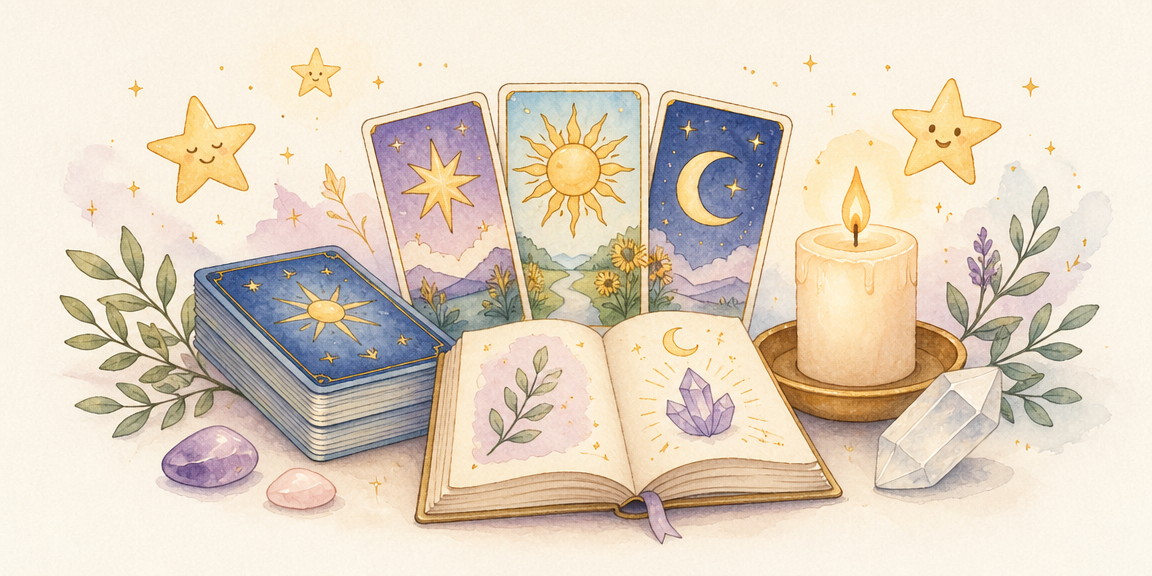
Tarot for Beginners: How to Start Reading Cards
A complete beginner's guide to tarot cards. Learn how to choose your first deck, master basic spreads, develop your intuition, and avoid common mistakes.
Read More