MBTI Soulmate Charts, Held Loosely: What Actually Predicts a Relationship
Why ENFP+INTJ compatibility charts are loose fun, the cognitive-function logic behind them, and what research says really predicts a relationship.
The Compatibility Chart Hit the Group Chat Again
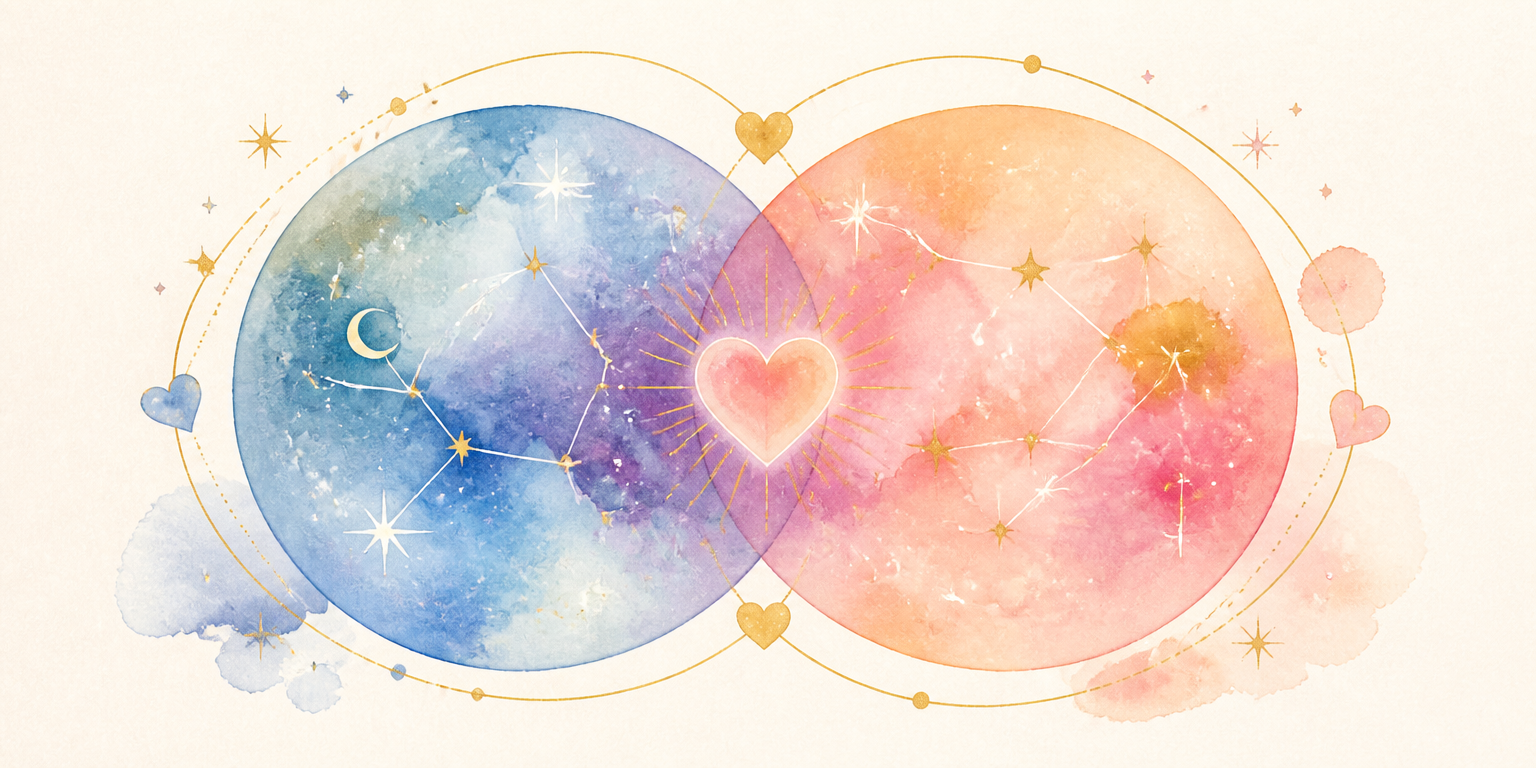
Last night a friend dropped a screenshot into our group chat. It was one of those charts with "ENFP × INTJ = Best Match" printed across it in a confident font. She has been seeing an INTJ for three months, she is an ENFP, so she added about five heart emojis and wrote "look, we're meant to be." Honestly I laughed and said "oh nice, it's official." It feels good. When someone you like shows up as a green light next to you on a chart, your brain enjoys that.
Then the next message landed weird. A different friend wrote, dead serious, "the guy I dated last was an ESTJ and we were a red match, so I guess that's why it ended." Something in me cooled off right there. Laughing at a chart and using a chart to explain a breakup are two completely different activities.
So let's talk about this. Taking the MBTI soulmate test for fun? I'm all for it. But once you understand *why* it's light entertainment, and what research actually points to when it predicts whether a couple lasts, you can enjoy the chart with a clearer conscience. Without using it to dump someone or chase someone.
Why the Chart Is Loose, in Plain Numbers
Start with a boring fact. There are 16 MBTI types. Pair two people and you get 256 ordered combinations, or around 136 unique pairs if order doesn't matter. Almost every chart floating around the internet crams those 136 pairs into three buckets: best, good, challenging. The trouble is the buckets disagree with each other. One chart calls ESTJ a "challenging" match for ENFP. Another puts the same ESTJ in the "complementary" column. Trace the sources and most of them have no basis at all. Somebody made a chart once and everyone copied it.
The deeper problem is the input itself. Type isn't as stable as people assume. In several studies, when the same person retakes the assessment a few weeks later, close to half come out with at least one of the four letters flipped. People who sit near the middle on T/F or J/P will swing based on the mood they were in that morning. So "INTJ × ENFP" is already a slightly mushy input. Running a destiny calculation on a mushy input is, by definition, a game.
And one more thing. Type averages people together. An anxiously attached ENFP and a securely attached ENFP are practically different species in a relationship, and the chart can't see that difference. It's looking at one of sixteen labels and ignoring the part of you that actually shows up at 11pm during a fight.
But Isn't Cognitive-Function Theory More Serious?
Here the people who've gone deeper into MBTI push back. "Sure, comparing four letters is dumb, I don't believe that either. But *cognitive functions* are different." This argument is at least worth hearing out.
In the Jung-based framework, each type runs a stack of four cognitive functions. INTJ is Ni-Te-Fi-Se. ENFP is Ne-Fi-Te-Si. Look closely and the two share the same functions (intuition, thinking, feeling) but point them in opposite directions. That's where the "they complete each other" story comes from. INTJ's convergent Ni prunes the branches while ENFP's divergent Ne keeps opening new ones. It sounds compelling. When I first read it I thought, oh, this feels almost scientific.
Let me be straight, though. Cognitive-function theory is closer to an *internally elaborate model* than to *validated psychology*. The measurement tools don't hold up well. Run two different function-stack tests on the same person and the results often don't agree. Jung drew this from clinical observation, not controlled experiments, and he was the first to say so. So function-based compatibility is a more detailed story than the four-letter version, but detailed is not the same as correct. A well-built astrology reading is also incredibly detailed. Detail is cheap. Predictive accuracy is the expensive part, and that's the part the theory can't really cash.
If you want to read the function stuff anyway, the MBTI guide hub breaks it down properly. Enjoy it. Just keep it on the same mental shelf as the horoscope next to it.
So What Actually Keeps a Relationship Alive?
This is the part that matters. Studies that have followed real couples for years, sometimes decades, mostly agree on what predicts whether a relationship lasts. Personality type barely shows up. What shows up instead is a short list of behaviors.
First, how a couple *repairs* after conflict. This is one of the well-known findings from John Gottman's research. Happy couples fight too. The difference is their ability to reconnect *after* the fight. A small joke. A hand reaching out: "sorry, I was harsh back there." A clumsy attempt to break the tension. Whether the other person accepts that repair attempt is what separates couples who make it from couples who don't. It has nothing to do with being an INTJ or an ESFP.
Second, the 5:1 positive-to-negative ratio. Gottman observed that stable couples maintained roughly five positive interactions for every negative one, even during disagreements. Warm comments, appreciation, a hand on the shoulder, laughing together. These accumulate like a balance in an account, and when a real fight comes, that balance is the cushion that absorbs it. Couples running near 1:1 are spending money they don't have.
Third, responsiveness. Whether you signal "I'm here, I've got you" when your partner is struggling. And here's a twist from Shelly Gable's work: how you respond to your partner's *good* news often matters even more than how you handle the bad. When your partner gets a promotion, the move is to be genuinely excited with them, not to immediately say "won't that mean more late nights, though." Active, engaged responding to good news builds intimacy. Deflating it quietly drains it.
Fourth, shared values and direction. Money, kids, where you'll live, how you spend a weekend. This has almost nothing to do with four letters. Two INFPs where one wants a city and the other wants a farm will find the chart's green light completely useless.
Notice the pattern? All four are *behaviors*, not *types*. And behaviors can change. Tell someone to fix their personality and you get a fight. But "let's agree that whoever's calmer reaches out first after we argue" is something two people can actually decide to do.
How to Enjoy the Chart Without Wrecking Anything
So am I telling you to throw the chart out? Not at all. I look at them for fun too. The thing that matters is how you use it.
The good use is as a *conversation prop*. "Ha, the chart says we're a challenging match, but honestly the way you decide stuff in two seconds, you are extremely a J." Pulling out each other's quirks as a joke. Used this way, the chart can come into the relationship without doing damage. It becomes an excuse to start a conversation you wouldn't otherwise have had.
The bad uses are two. One is the dumping excuse. "We were a red match, I guess we just weren't compatible" is usually a person who wants out and is handing the responsibility to a chart. Saying "honestly, my feelings have faded lately" is more honest, to your partner and to yourself. A chart should never get to take the fall for a decision you made. The other is the chasing excuse. Clinging to someone who isn't right for you because a chart said green. Whether you feel at ease around them, whether they actually listen, whether the air clears after a fight, those are signals a hundred times more accurate than any pairing table.
What I ended up telling my friend was this. "I hope it works out with that INTJ. But if it does, it won't be because of the chart. It'll be because he hears you out to the end and you cool off easily when he cracks a joke." The chart was just the thing we laughed at first.
If you want more of the light tests and guides in this spirit, the full guides are worth a wander. They're all built the same way: serious on the surface, a game underneath.
The One-Line Version
The MBTI compatibility chart is a fun chart, not a verdict on your future. It's a game built on a wobbly input (your type shifts with your mood) topped with an unvalidated theory. The real fate of a relationship doesn't live in four letters. It lives in who smiles first after the fight. So use the chart up to the point where it makes the group chat laugh, and then look at the actual person instead of the label. That's more fun, and it hurts a lot less.
Related picks
This section may contain Coupang Partners affiliate links. We may earn a commission from qualifying purchases.
MBTI 책
성격 심리 책
커뮤니케이션 책
Try This Quiz
Taking the quiz is even better than reading about it!
Related Articles
MBTI Compatibility: Which Types Work Best Together?
A deep dive into MBTI compatibility — socionics-based matching, cognitive function pairing, and communication tips for every type combination.
Read More
MBTI Love Styles: How Each of the 16 Types Falls in Love
Discover how each MBTI type loves. From analysts to explorers, learn dating patterns, best matches, and conflict points for all 16 personalities.
Read More
INFJ vs INTJ: How to Tell the Two 'Rarest' Types Apart
INFJ and INTJ both lead with Introverted Intuition, so they look alike from the outside — here's the Fe-vs-Te tell that actually separates them.
Read More