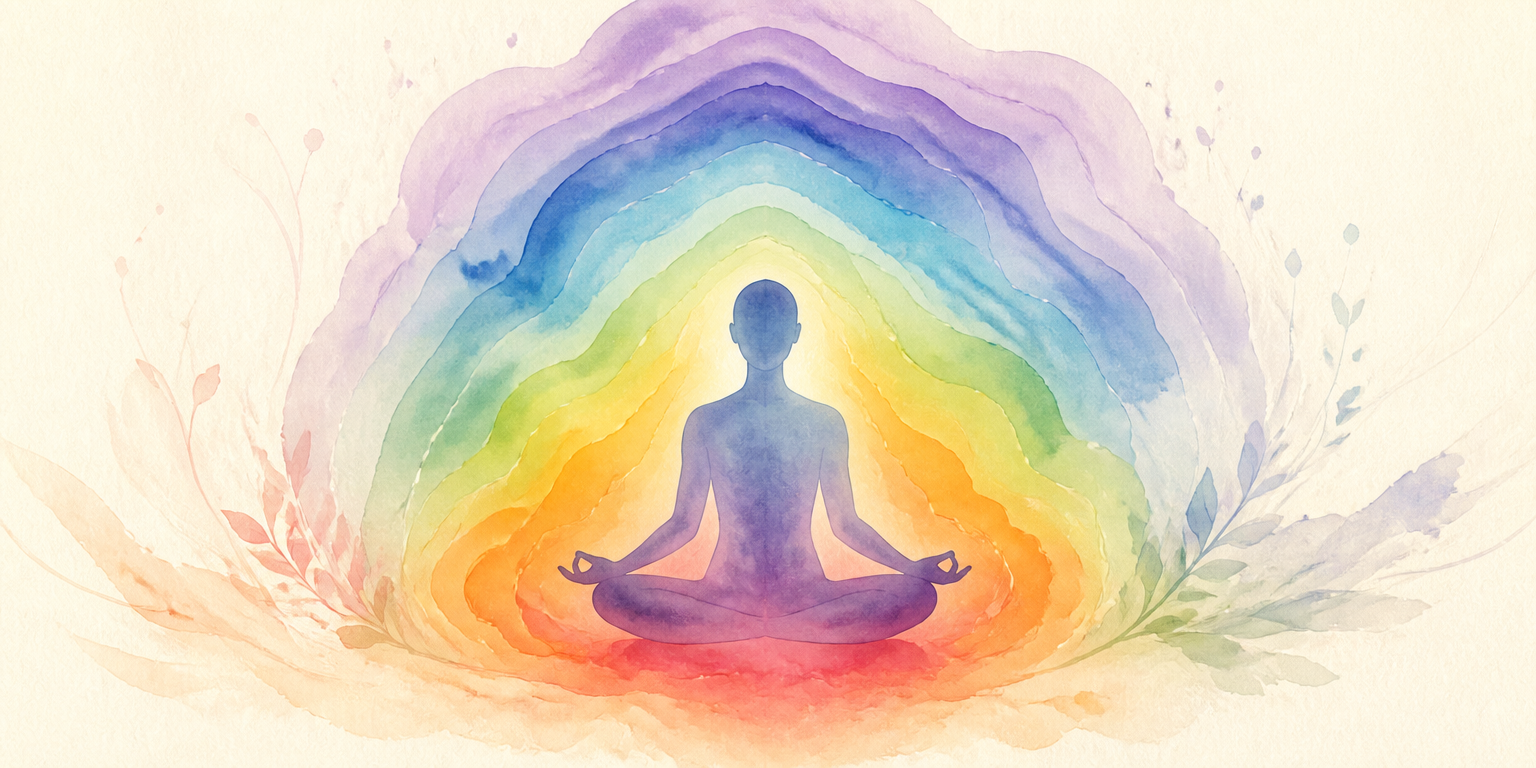
What Each Aura Color Means — A Mood Lens, Not a Photograph
Red through white — the mood and temperament traditionally tied to each aura color. A creative mood lens, not an energy field you can measure.
What an aura color actually is, honestly
When a friend says "you've been really blue lately," you know exactly what they mean. Quiet, a little sunk, fewer words. That's the whole idea behind aura colors. Nobody's running a scan. You're putting a color name on the *mood* a person gives off.
There are shops that claim to photograph your aura. The machine reads faint electrical signals from your palms and turns them into colors on a printout. Honestly? That's a pretty picture, not a measurement of an energy field. No glowing aura has ever been verified by science. So let me put the cards on the table before we start: aura color is a *symbolic mood lens.* It's not light coming off your body. It's a mirror you hold up to ask, "which color is my temperature closest to right now?"
Funny thing is, once you stop trying to make it literal, it gets more useful, not less. You're not arguing about whether it's true. You're just asking yourself a soft question: what color am I today?
With that framing locked in, let's walk the colors.
Red and orange — the colors of a body that's awake
Red is traditionally the hottest one. Drive, desire, the raw sense of being alive. The red mood walks into a room and the air speeds up half a step. It's the color of anger, of falling in love, of crossing a finish line with your lungs on fire. It's the color of *I don't want to sit still.*
But red gets scorchy when it runs too strong. Restlessness. A short fuse. Acceleration with the brakes cut. On a day when red feels loud in you, it's worth a quick check: am I actually boiling right now, or just busy?
Orange is red's more social cousin. If red is "charge alone," orange is "come play." Creativity, curiosity, the kind of energy that switches on around other people. In an orange mood you want to start three new projects and you'll talk to a stranger in line without thinking twice. The classic orange trap: you start ten things and finish two. Great at the spark, shaky at the follow-through.
Yellow and green — the head and the heart
Yellow is sunlight. Bright, quick-witted, optimistic. The yellow mood cracks the joke, makes a heavy conversation feel lighter, and never quite runs out of curiosity. It loves learning for the fun of learning. In most friend groups, yellow is the one keeping the temperature warm.
The shadow side: when yellow burns too bright, it scatters. Width over depth, novelty over staying power. "There's too much interesting stuff to sit with any one thing" is the yellow problem in a sentence.
Green drops a tone and moves toward the heart. Healing, balance, growth. The green mood is oddly reassuring to be near. It keeps plants alive, listens well, and slides into the mediator seat the moment a conflict shows up. The person everyone ends up confiding in is usually running green.
Green's trap is self-deferral. It tends everyone else's garden and forgets to water its own. In a season where green feels strong, the useful question is simple: am I receiving anything right now, or only giving?
Blue and indigo — a floor deeper, inward
Blue is the calm one. Quiet, trustworthy, thought running half a beat ahead of speech. The blue mood would rather have one long conversation with two people than a loud party with thirty, and it keeps its promises. Wide, deep, sky-and-ocean steadiness.
Go too deep and blue turns melancholy. There's a reason "feeling blue" means what it means. Sinking can be recovery, but if you get stuck down there it just gets lonely.
Indigo goes one floor below blue. Intuition, insight, the "I can't explain how I know, I just know" color. The indigo mood reads a room in fine detail and catches the pattern under the surface that nobody's named yet. Sometimes even the person can't say where the knowing came from.
Indigo's shadow is an overcrowded head. It runs a hundred simulations and burns out on the processing. On a heavy indigo day, the medicine is to switch the thinking off and move the body for a while.
Violet and white — the colors that travel furthest
Violet has long been treated as the "highest" color. Imagination, spirituality, artistry. The violet mood keeps one foot in the real world and one in a dream. It paints pictures other people can't see yet and makes ordinary things feel charged. The catch: its feet leave the ground sometimes, so it wobbles in front of hard deadlines and spreadsheets and other unromantic facts.
White is both the end of color and the start of it. Combine every color of light and you get white. So white means clarity, purity, the clean feeling of a fresh start. The white mood is uncluttered, aligned, pointing one direction. A clear-headed morning, the moment right after a big decision lands, the day after you finally close out something that's dragged on for months — that reset state is white.
White's one trap: chase emptiness too hard and you can come off cold or far away. If you scrub off your own feelings in the name of staying pristine, it gets lonely up there.
So how do you actually use this
The best use isn't a diagnosis. It's a check-in. Look in the mirror in the morning and ask, "what color am I today?" If the answer is red, follow it with "am I boiling, or just moving fast?" If it's blue, "I'm sunk — is this recovery or am I stuck?" If it's yellow, "this is light and good, but could I sit with one thing for an hour?" The color isn't the answer. It's the door that opens a better question.
One more thing worth saying twice: an aura color is weather, not a label. Not "I'm a violet person for life" but "this week has a blue grain to it." A sprint season pulls red up; a rest season lets green settle in. Color moves around inside one person all the time. So don't cage yourself inside a single result.
If you're curious where you're sitting right now, the aura color quiz is a fun two-minute check. If you like reading yourself through symbolic lenses — stars, moon phases, that sort of thing — the astrology guide hub is worth a wander too. And if you want a different topic entirely, the full guides library has plenty more.
A light note to close on
Aura color is symbolic self-reflection for fun. It isn't fortune-telling, it isn't a medical fact, and it isn't a measurable energy field. Carry it like a small mirror you glance into now and then to ask which color your day is closest to. Held that lightly, it works better than it has any right to.
Related picks
This section may contain Coupang Partners affiliate links. We may earn a commission from qualifying purchases.
문페이즈 다이어리
별자리 책
무드등
크리스탈 소품
Try This Quiz
Taking the quiz is even better than reading about it!